Tuesday, May 28, 2019

Review Article: Outside In

Margins of Islam: Ministry in Diverse Muslim Contexts

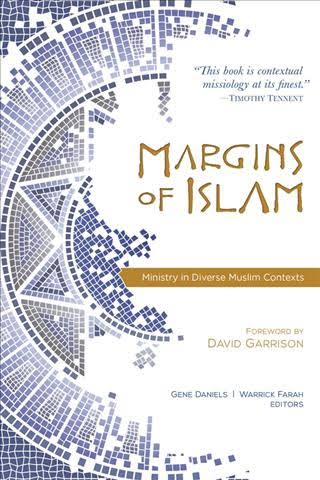
Edited by Gene Daniels and Warrick Farah (Pasadena: William Carey), 2018, 240pp, £12.30 (Amazon), £7.66 (Kindle)
I was in Indonesia last year, teaching in a couple of seminaries.[1] That vast archipelago constitutes the most populous Muslim-majority nation on Earth. Just a few months earlier, the country was shocked when radical Islamists (from one family as it happens) killed thirteen worshippers at Easter services in the city of Surabaya.[2] That violent extremism seemed far away from the folk I met there, such as the middle-aged hijabi who sat next to me on the long train journey across the island and offered me a share of her snacks. I also met the leader of a movement of people, outside mainstream evangelicalism, who meet regularly in small groups to read the Bible and worship Jesus. After twenty years, the movement’s leaders reckon their numbers have now reached six figures. The key feature of these vignettes for our purposes is that all these people would identify as Muslims.
Since then, I have met a number of Muslims as I have visited universities around the UK. Let me introduce some of them to you: the young Mancunian woman in her hijab, the mature Iranian man who dare not go home for fear of the state, the Algerian researcher trying to make sense of the modern world, the Egyptian postgraduate student who asked me why Christians are so private about their religion, and the young Saudi woman who told me she had rejected Wahabi Islam when she saw what IS was doing.
What staggering diversity. How do we make sense of Islam in a world of such variety? What, after all, is Islam? Is it a religion or a way of life or something else? 
This book is a major contribution to understanding Islam and ministry to Muslims. Read more here.

Thursday, April 18, 2019

Winter into Spring VIII: Muslims

In both Newcastle and Dundee, especially the latter, the events were attended by a number of Muslim students. I was struck by the diversity in this ‘community’. There was the British young lady in her hijab, the mature Iranian man who can’t go back home for fear of the state, the Egyptian post-graduate student who asked me why Christians are so reticent to be public about their religion, the young lady from a very tightly-controlled country who told me she had rejected the Wahabi interpretation of Islam when she saw what IS was doing, and the Arab student who identified as an atheist (more about him later).
Those that attended events listened respectfully and were happy to discuss the issues that arose. There were no heated arguments, no verbal attacks. On first entering the marquee they were perhaps a little uncomfortable, wondering, probably, if they were allowed. But a welcome by a student or CU guest soon put them at ease.
One leader of the Islamic Soc. in Newcastle attended a lunch bar and asked me a load of questions about the logistics of the venue, etc.: he was getting ideas for their own events week!
Another male student, from Pakistan, came during the morning slack time when the marquee was open for coffee. We had a respectful and frank exchange of views and I gave him my email if he should want to contact me later. I received an email a few weeks later apologising if he had given offence (he had not) and said he would come back to me with more questions.
The high point from the point of view of witness to Muslims, was the dialogue between an Imam and a Pastor in Dundee. Imam Jabil, a local mosque leader, shared the stage with Duncan Peters from Glasgow, with the two-hour event ably chaired by a retired Dundee lecturer. The chair had made a list of questions which he asked in turn, with each man having three minutes to answer each question. At the end, questions were fielded from the floor, with the whole event lasting two hours.
About 15 Muslim students attended as well as around the same number of CU members and a few of us others. The Arab atheist stood at the back nearly the whole time (arriving slightly late). He was clearly flabbergasted at what he was witnessing – a friendly sharing of views. He asked me who had organised the event. Afterwards he stayed to talk, not giving too much away but telling me he was unimpressed by the answers the Imam was making.
I thought this event was a modest success. The big gain for the CU is that it provided an environment for building relationships and in which the sharing of the gospel was entirely natural. It was important for those of us who organised this that the event should not be a debate but a dialogue. The former can sometimes cause people to feel threatened, leading them to become defensive and combative. Here no one felt under attack; all were happy to talk afterwards. Duncan’s fresh translation of Luke’s Gospel – Holy Injil: Luke– was available for people to take afterwards. A number of the Muslims who attended came back for subsequent events.
It would be great to see such events put on in universities throughout Europe, especially where there are a significant number of Muslim students. We need to help students to create concrete ways in which they can show love to their classmates, and in which the truth of the person of Jesus and his saving work can be shared respectfully and humanely.

Wednesday, April 17, 2019

Winter into Spring VII: Hindus


I got to share the gospel with a number of Hindus in all four locations I visited over the past few months. Nearly all were international students.
in Dundee a group of post-graduate students from India joined us for dinner one evening. It was hard to discern if they had anything more than a passing interest in what was going on. They asked intelligent questions and listened respectfully. There was a marked ignorance (I don’t mean that pejoratively) among the group, of our message. One asked me, “You know there are three types of Christianity?” I asked him what he meant, and he replied, “You know, those who worship Jesus, those who worship Mary, and those who worship Satan”! Some serious groundwork needed there. These were intelligent young men but with very little awareness of who Jesus is or what he has done. (On a side note, I just about managed to prevent them from eating the beef – ‘Cottage Pie’ could be anything to the uninitiated. Thankfully there was a vegetarian option.)
Two Hindus stood out for me. One was a young lady in Aber who had migrated from Nepal in her mid-teens. She had heard of Yeshu in Nepal and thought it must be a foreign god. She was astonished when I told her that the Jesus who we talk about here is the same person!
I had the joy of interacting with one recent Indian graduate in Utrecht. He had been involved in a Globe Café and was reading John Uncovered with his new friends. We talked seriously until it was time to leave. His first question to me after hearing Lindsay speak on ‘Why Bother with Jesus’ was this: If this is true what does it mean for the Indian villager who has never heard? Wow! This was no smug attempt to humiliate me – he was probably thinking of his grandmother. I told him how we all alike are held responsible for the way we have handled the light we have received and that we can only be saved by conscious faith in the Lord Jesus Christ. His reaction was to say something along the lines that, if that is the case, people need to get the message out. Indeed.

I wrote a piece on Sharing Jesus with Hindu Friends for bethinking here.


Tuesday, April 16, 2019

Winter into Spring VI: Roman Catholics


As last year, I had some very good conversations with students (and one tutor) who are practising Roman Catholics. One, an African student, had never heard an evangelical explanation of the cross of Christ. She came back later in the week and showed me how her Bible readings have taken on a new freshness – I had directed her to Romans and Hebrews. She is now in a follow-up group. The tutor told me frankly that he had been going to church his whole life, his friends had now all given up, and he was seriously wondering if it was all worth it.
The way I approach Roman Catholics is this: I tell them they have a great tradition – the Creeds and Councils of early Christianity. But traditions are always mixed because the people who develop them are not pure in their motives and make mistakes. So, we need something that is not dependent on the tradition to critique it and correct it. That’s the Bible, that has come to us from God himself and therefore should be respected as the ultimate authority. And we go from there. Not all will buy it – one graduate I talked with in Newcastle was sufficiently astute to realise my argument didn’t fit with official dogma and would not countenance going any further with it. But he kept coming along to the lunch bars, as he has done for years.
Any thoughtful Roman Catholic will have loads of questions that follow. If they have understood the argument for the authority of the Bible (even if they haven’t yet come to agree with it) they will be happy to hear how the Bible answers those questions.

Monday, April 15, 2019

Winter into Spring V: sub-Saharan Africans


In most of the universities I met a few students either from Africa itself or of African heritage. I will mention some under Islam and Roman Catholicism but here want to point out an African group of which we need to be aware – those who are scarred by the prosperity gospel. This is, of course, no gospel at all but a false teaching. In its milder forms it is repeated by poorly trained pastors who are simply not reading their Bibles carefully, leading to disappointment and disenchantment. In its extreme forms it can involve serious child abuse and even murder. In between are a host of different churches and denominations, many of which have a presence in the UK. Young people are coming to university in the UK from a background that is heavily impacted by such groups. 
On the one hand there will be those, like a young lady I met before in Leeds, who are sceptical of the claims of the gospel because they have never had their questions answered. Prosperity preachers confuse the gospel with material success and seem to have no inclination to engage with the difficult questions that are pressing to their young people – sexuality, climate change, work. 
On the other hand, there will be those, like a young man I met in Newcastle, who have been badly burned by their experience of church. Jim, I will call him, recounted how he had gone with his mother to a big event at the O2 Arena as a child and been thoroughly turned off by the obvious fraud that was going on – fake healing etc. He now considered himself an agnostic.
So young people from such backgrounds arrive at university with a shaky faith (if any) and a tenuous attachment to church. Reaching out to such students in their early days is vital if they are not going to be lost altogether.
Even still, however, events weeks will pull some along. They will listen. They will ask questions. Are we sufficiently aware of these folk and ready to handle them sensitively?

Friday, April 12, 2019

Winter into Spring IV: Chinese

As I pointed out yesterday, a number of CUs are actively seeking ways to engage international students in their events weeks. It is a joy for me to have been involved invited to help out with this. It is a great opportunity to share the gospel with such students while they are studying here. If they come to faith in Christ, then they get to take the Lord Jesus back with them to their families and friends. Friends International have staff workers in many towns and cities across the country supporting CUs and local churches in this ministry.
I have said before that CUs are doing so well in reaching out to sceptical British students, with their persuasive evangelistic approach. And many are putting a lot of effort into hospitality, especially in efforts to reach international students.
There are large numbers of students getting missed out, though, including British students from other religious traditions and internationals who have a strong sense of attachment to their own tradition. We need to be looking for ways to engage these folk as well as learning ways to be more sensitive to their heritage.
In the following blog posts, I will address ministry to such students grouped into the following categories: non-Muslim Africans, Roman Catholics, Hindus, and Muslims. But here I will start with a few words about the Chinese. A word of caution: this is all anecdotal; I have had little experience of this ministry compared with others. These are my observations and reflections only, not a thoroughgoing analysis.
In recent decades, in the West, there has been a significant movement of Chinese students to Christ, matching the great movement of Chinese more generally back home. I remember leading an Uncover John study with a tableful of Chinese students in Durham four years ago. They were so eager and so quick to pick up what we were sharing with them. I wonder if that window of blessing is closing now. I met many Chinese students on campuses over the past few months. In Dundee especially, I handed out hundreds of flyers to students from mainland China. But very few came along to events. Nothing wrong with the flyers – they were well-designed, and the information was clear. But there seemed to be a hardness I have not encountered before. Is it busyness? Surely that has always been the case. Could it be that the increasing hardness of the regime against the church in China is galvanising opposition against the gospel more generally? What about the Orwellian social credit system? Is that causing students to keep their heads down even when they are off camera and in another country? This is worthy of more research.

Thursday, April 11, 2019

Winter into Spring III: Food


One topic in student ministry worth thinking about more is food – the great mark of hospitality. What better way is there to demonstrate love in a tangible way to our guests? A proper hot meal is characteristic of all the best events I have been involved in recently. Take the Aberystwyth CU special Globe Café, for example. Aber CU has a thriving Globe Café on Thursday evenings throughout the year, run by the students. This has become so fruitful that the CU has given over one of their regular CU meetings on Monday nights to a special Globe Café (without cancelling the Thursday event). I visited them for their Chinese New Year celebration. A big help for them is a post-doc Chinese student who is a great cook. Food was hot, tasty, and plentiful. The room was packed with Globe Café regulars and other CU members as well as some who had never been before.
In Dundee, the students put on an International Meal at 6 o’clock each evening in the marquee. As at Aber, hot food was served and much appreciated. This was cooked by local church members and brought over just in time for the meal. Sometimes the quantity was insufficient because more students turned up than expected. But it was good food. The talks given by me were short. My intention was to make international guests feel welcome and to pique interest in the main event to follow, rather than make it self-contained. I think this worked well. We also had an interview on two evenings, though I thought they were a mixed bag.
In Newcastle, the CU set their sights higher still, with the plan to feed everyone at the main evening event – a tall order when up to 100 were jammed into the marquee. They faced a big obstacle as well: having a marquee provided by the Students Union, they were obliged to follow their dictates, which were only to use the SU’s regular caterers. The upshot of this was cold food served in boxes. The students worked very hard to make a go of this and the food was certainly acceptable, but it lacked the welcoming warmth and smell of a hot meal.
The Newcastle CU pushed the boat out further by adding an ‘International Track’. It is great to give international students an invitation to events specially for them – part of what it means for the church in the UK to welcome the stranger in our midst (Lev 19:34). The arrangements for the main event, however, meant that canapés and squash from 5pm in a different building off-campus was not much of a draw. One who did come, though, – and from a different religious tradition – went on to attend other events and signed up for the follow-up course, so there was fruit even from this.
On the first evening, some of us skipped the main event in the marquee and popped over to a local church, where their weekly Globe Café was going on, with maybe 150 present – a mix of international students and church folk. This is a thriving regular work that feeds into a number of other activities during the week, including English classes and discovery Bible studies. It seems to me that some joined up thinking needs to go on here: would it not be better if the events week started on the Tuesday, with a big encouragement given at the Monday Globe Café, for international students to join in? As it was, the events week was scheduled to finish on Thursday because of other arrangements for the weekend. Clearly, cutting off the first evening event would have severely limited the effectiveness of the week. In hindsight, however, expecting international students to give up four hours of their evening was probably unrealistic. The Dundee model could be a great one for CUs to emulate.