[This message was given at the close of a half-day conference with EMF at my church, Freeschool Court Church, Bridgend, Wales, on 19th November 2022. I had been asked to stand in for my friend who was not well.]
We have been listening throughout the morning to the great challenge of taking the glorious message of the gospel of Jesus Christ to the dark continent of Europe.
And what a challenge it is!
How can we be faithful in reaching Europe with the gospel in the 21st Century?
It seems to me that there are two miss-steps we can make as we think through that question:
1. It all comes down to strategy. We need to research the European scene in careful detail, analysing the social demographics, and interpreting the cultural themes that dominate the minds of her people. Then we need to assess methods of engagement, adopt successful models, manage our ‘human resources’, train a rising generation in the latest in effective mission techniques, invest in dynamic technologies, and develop a sustainable support base to ensure that we can always affirm that “God’s work, done in God’s way, will never lack God’s supply.”
2. It all comes down to the Holy Spirit. We need to allow the Holy Spirit to lead the ministry. If we are truly spiritual people, we will be filled with the Spirit and we will be able to operate in the power of the Spirit rather than in the power of the flesh. In the spirit of the Proverbs, if in all our ways we acknowledge him, he will direct our paths. And in that way, we will taste success in in such a way that has never before been seen in the history of missions. The Spirit will give us Europe.
Now, these are really caricatures, and in practice we may be hard pressed to find such extreme thinking in reality. But we can readily find examples of churches and organizations who have adopted one or the other of these models as their general approach.
Why do I say these two approaches to ministry in Europe today are miss-steps? For a simple reason: each, at least in these stereotypical forms, leaves no room for the other. They are totalizing. All you need, say both camps, is this. They are Shredded Wheat approaches: nothing added, nothing taken away.
How should we move forward in the great task of disciple making 20 centuries after the Lord first gave his disciples his final instructions?
It seems to me that we need to have a two-dimensional approach. And I think we can see that very clearly in the story of the way the gospel first came to the mainland of what we now call Europe, around the year 50AD. Turn with me to Acts 16:6-15.
So in this wonderful story, we observe two dimensions of pioneering evangelism – with apologies to Jane Austen – sense and sensibility:
1. Sense
Imagine the scene: Paul and his companions are walking through the hot, dry interior of what is now called Turkey. Where are they going? They were not wandering around the Mediterranean Basin in a random manner.
If you look carefully at Paul’s movements throughout the book of Acts, you will be struck that Paul was intentional in all he did. Remember how he was sent out from Antioch, and how he and Barnabas “went down to Seleucia and sailed from there to Cyprus” (Acts 13:4)? Why did they go there on their first excursion? We are not told, but that fact that we are told that Barnabas was from Cyprus surely gives us a very strong clue. That was Barnabas’ place. He knew it well. He had connections. They could stay with relatives. He understood the Cypriot mindset and could help Paul to avoid some of the faux pas that every cross-cultural worker knows so well.
But where do they go when they land in Cyprus? The port towns of Salamis where they landed and Paphos from where they sailed for Perga in Pamphylia to the north. And that is what we see on all Paul’s gospel journeys – he makes for important cities and when he arrives proclaims the gospel, often staying until he is kicked out.
Clearly, Paul and his companions were seeking to evangelise according to a plan, according to an approach, according to a strategy. They were in other words, using their sense. Using their God-given gift of intelligence.
In Paul’s letter to the Romans he tells them that he had “planned many times to come to you” (Rom 1:13). At the end of his letter, he outlines his whole approach to his ministry: “It has always been my ambition to preach the gospel where Christ was not known, so that I would not be building on someone else’s foundation” (Rom 15:20). Then he tells them of his ‘plan’ to visit them on his way to Spain (24).
In the same way, Paul discusses his plans to visit the church in Corinth (2 Cor 1:15-17).
Now this is important. As we have seen, there are those who suggest that strategic planning is unspiritual. They criticise those who spend time researching the people among whom they are hoping to witness. “Just go out and see how the Spirit leads you,” they say. Strategy is unspiritual.
Not so to Paul. And that is why he and his companions, Silas and Timothy, were on their way through the interior. They had revisited the cities at which they had previously preached: places like Derbe and Lystra. And now they are heading west. Where are they going? They are heading to the Roman Province of Asia. Now that is not the vast continent we call Asia today. Asia in Paul’s day was a much smaller region – a Roman Province. And, more importantly, Paul is heading for Ephesus, the principal city of the province. How do we know that? In v. 6 we read that they had “been kept by the HS from preaching the word in the province of Asia.” But there is further evidence: this verse begins a new act in the drama of the Acts of the Apostles. You can see it is a new act because the previous verse is one of Luke’s summary statements (5).
So Asia is mentioned right at the beginning of this section – of this act. Paul is wanting to preach in Asia, and especially at its principal city, Ephesus. He doesn’t manage to get there at first but gets diverted – more on that in a minute. But after he and his team travel all around Macedonia and Achaia they do in fact end up in Ephesus (19:1). Finally, phew, they arrive in the great city and have such a fruitful visit they end up staying for over two years (19:10). And so Luke can wrap up that act in the drama by showing how Paul’s plan had been successful, even though he had had to get there in a convoluted manner (19:20).
So really, Paul’s ministry in Macedonia and Achaia could be described as a diversion from Paul’s plan. But what a diversion it was. And that leads us to the other dimension of pioneering evangelism:
2. Sensibility
By this I mean, sensitivity, or the ability to perceive the leading of the Spirit.
Paul and his companions “were kept by the Holy Spirit from preaching the word in the province of Asia” (Acts 16:6). That would mean nothing if they hadn’t been prevented from carrying out a plan. In the next verse we read that they “tried to enter Bithynia, but the Spirit of Jesus would not allow them to.”
We are not told in what way the Holy Spirit had prevented them from ministering in Asia and Bithynia. Perhaps there was a word of prophecy. Or a dream. Or maybe it was circumstantial, a river in flood across their path, for instance. We are not told. But whatever it was, Luke tells us that it was the work of the Spirit. And they recognised it as such. That is what I mean when I say they had sensibility, or sensitivity.
And so they pass by Mysia and make their way down to the port city of Troas (8). And it is there, during the night, that Paul has a vision of a man of Macedonia standing and begging him, ‘Come over to Macedonia and help us’ (9). Well, you would think with such sensibility as Paul evidently had it would be a no-brainer. But read on and how do we find them responding to that vision (10)? Don’t miss it. They “concluded that God had called [them] to preach the gospel to them.” How did they do that? They must have talked it over. Paul could be very strong when he needed to be. But he did not issue a directive. He mulled it over with his companions, Silas and Timothy and now also Luke.
I love that about Paul. He planned, he strategized, he used the sense that God had given him. But he was also sensible – sensitive to the leading of the Holy Spirit in extraordinary ways. And even with such extraordinary leading, he still discussed it with his companions. Wouldn’t you have loved to be part of that team? No heavy handedness, no throwing his weight around, no abuse of power. A far cry from the way that some gospel workers operate.
So, they put to sea and arrive in Neapolis (11). And after disembarking they make their way up the hill on the outskirts of the town, and down the other side, heading inland through the Macedonian scrubland to find the Egnation Way, the Roman road that linked the eastern part of the empire with Imperial Rome itself. And after a few hours of walking, there it is.
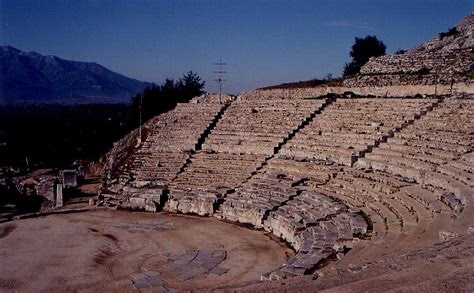
They join the road with its marble flagstone heavily rutted by the chariots and carts of numerous Roman legions, and head west for the important Roman colony of Philippi. They can see the rocky hill of the Acropolis up ahead, above the city. And finally they arrive at their destination. It is a small city – less than half a mile across and packed with houses, administrative buildings, a market place and forum, and off to their right, at the foot of the Acropolis, the amphitheatre whose acoustics no doubt Paul was eager to try out.
And we are told that they stay there several days. They need to rest after their journey. No doubt also they are praying that the Lord would open up a door of opportunity for the gospel.
And so it is that, on the Sabbath, they make their way passed the prison on their right and out of the city, and ten minutes later arrive at a small river, where, just as they expected, they find a place of prayer (13). And it is there that they speak to the women who have gathered.
And then read this: “One of those listening was a woman from the city of Thyatira named Lydia, a dealer in purple cloth.” And then these wonderful words: “The Lord opened her heart to respond to Paul’s message” (14).
And that is how the gospel first came to the European mainland.
What Can We Learn from This?
We must always resist the temptation to reduce the ministry that the Lord has given us to a single dimension. It’s not sense or sensibility. It is sense and sensibility. And that means we can learn two lessons for our ministry in Europe today:
1. The Lord has given us minds. And one of the works of the Spirit in the life of a believer is to elevate our minds so that we can think clearly and be wise in the way we act. So it is entirely appropriate for us to do our demographic research and our social analysis and our cultural interpretation. Because that is a God-glorifying use of our rational faculties. That is why, a few weeks later, Paul could say to the Athenian philosophers, “As I walked around and looked carefully at your objects of worship, I even found an altar with this inscription: TO AN UNKNOWN GOD” (Acts 17:23). What a thing for the zealous Jew Paul to do! Before he came to Christ, he would not have been seen dead near a detestable idol. But now the Lord had liberated him from that scrupulosity. He would observe their artefacts. He would read their poets. He would find points of contact, the bridges of God, and he would cross them with the gospel. He was not worried about being polluted by false religion. He would reason with everyone who would want to engage with his message.
2. The Lord has not left us as orphans. He has given us his Spirit. You remember the last words of our Lord before he was taken up into heaven in front of his disciples: “…you will receive power when the Holy Spirit comes on you; and you will be my witnesses in Jerusalem, and in all Judea and Samaria, and to the ends of the earth” (Acts 1:8). The Spirit would lead them. And he would ensure that the gospel would ring out across the globe. Even to Europe, and the other ends of the earth. And sometimes he will do that by diverting us away from our best laid plans and sending us to a country controlled by the mafia, a university controlled by the thought police, or a sink estate where no one controls anything.
May the Lord give us grace to use the gifts he has given us and the wisdom and sensitivity to recognise when he will have us go out of our comfort zone and step into the unknown, trusting him to lead us. Amen.