Showing posts with label Islam. Show all posts

Tuesday, May 28, 2019

Review Article: Outside In

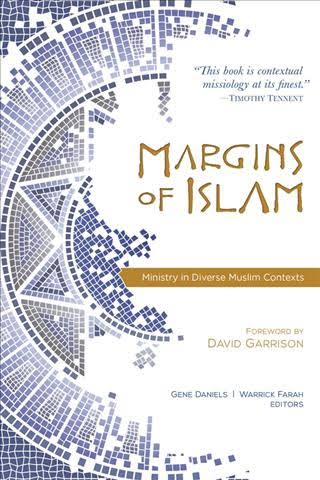
Margins of Islam: Ministry in Diverse Muslim Contexts

Edited by Gene Daniels and Warrick Farah (Pasadena: William Carey), 2018, 240pp, £12.30 (Amazon), £7.66 (Kindle)
I was in Indonesia last year, teaching in a couple of seminaries.[1] That vast archipelago constitutes the most populous Muslim-majority nation on Earth. Just a few months earlier, the country was shocked when radical Islamists (from one family as it happens) killed thirteen worshippers at Easter services in the city of Surabaya.[2] That violent extremism seemed far away from the folk I met there, such as the middle-aged hijabi who sat next to me on the long train journey across the island and offered me a share of her snacks. I also met the leader of a movement of people, outside mainstream evangelicalism, who meet regularly in small groups to read the Bible and worship Jesus. After twenty years, the movement’s leaders reckon their numbers have now reached six figures. The key feature of these vignettes for our purposes is that all these people would identify as Muslims.
Since then, I have met a number of Muslims as I have visited universities around the UK. Let me introduce some of them to you: the young Mancunian woman in her hijab, the mature Iranian man who dare not go home for fear of the state, the Algerian researcher trying to make sense of the modern world, the Egyptian postgraduate student who asked me why Christians are so private about their religion, and the young Saudi woman who told me she had rejected Wahabi Islam when she saw what IS was doing.
What staggering diversity. How do we make sense of Islam in a world of such variety? What, after all, is Islam? Is it a religion or a way of life or something else? 
This book is a major contribution to understanding Islam and ministry to Muslims. Read more here.

Thursday, April 18, 2019

Winter into Spring VIII: Muslims

In both Newcastle and Dundee, especially the latter, the events were attended by a number of Muslim students. I was struck by the diversity in this ‘community’. There was the British young lady in her hijab, the mature Iranian man who can’t go back home for fear of the state, the Egyptian post-graduate student who asked me why Christians are so reticent to be public about their religion, the young lady from a very tightly-controlled country who told me she had rejected the Wahabi interpretation of Islam when she saw what IS was doing, and the Arab student who identified as an atheist (more about him later).
Those that attended events listened respectfully and were happy to discuss the issues that arose. There were no heated arguments, no verbal attacks. On first entering the marquee they were perhaps a little uncomfortable, wondering, probably, if they were allowed. But a welcome by a student or CU guest soon put them at ease.
One leader of the Islamic Soc. in Newcastle attended a lunch bar and asked me a load of questions about the logistics of the venue, etc.: he was getting ideas for their own events week!
Another male student, from Pakistan, came during the morning slack time when the marquee was open for coffee. We had a respectful and frank exchange of views and I gave him my email if he should want to contact me later. I received an email a few weeks later apologising if he had given offence (he had not) and said he would come back to me with more questions.
The high point from the point of view of witness to Muslims, was the dialogue between an Imam and a Pastor in Dundee. Imam Jabil, a local mosque leader, shared the stage with Duncan Peters from Glasgow, with the two-hour event ably chaired by a retired Dundee lecturer. The chair had made a list of questions which he asked in turn, with each man having three minutes to answer each question. At the end, questions were fielded from the floor, with the whole event lasting two hours.
About 15 Muslim students attended as well as around the same number of CU members and a few of us others. The Arab atheist stood at the back nearly the whole time (arriving slightly late). He was clearly flabbergasted at what he was witnessing – a friendly sharing of views. He asked me who had organised the event. Afterwards he stayed to talk, not giving too much away but telling me he was unimpressed by the answers the Imam was making.
I thought this event was a modest success. The big gain for the CU is that it provided an environment for building relationships and in which the sharing of the gospel was entirely natural. It was important for those of us who organised this that the event should not be a debate but a dialogue. The former can sometimes cause people to feel threatened, leading them to become defensive and combative. Here no one felt under attack; all were happy to talk afterwards. Duncan’s fresh translation of Luke’s Gospel – Holy Injil: Luke– was available for people to take afterwards. A number of the Muslims who attended came back for subsequent events.
It would be great to see such events put on in universities throughout Europe, especially where there are a significant number of Muslim students. We need to help students to create concrete ways in which they can show love to their classmates, and in which the truth of the person of Jesus and his saving work can be shared respectfully and humanely.

Wednesday, July 19, 2017

Cross-Currents in Muslim Ministry: A Review Article of A Wind in the House of Islam

A Wind in the House of Islam: How God Is Drawing Muslims around the World to Faith in Jesus Christ, by David Garrison (Monument, Col.: WIGTake, 2014).

The House of Islam, Dar al-Islam in Arabic, is “the name Muslims give to an invisible religious
empire that stretches from West Africa to the Indonesian archipelago, encompassing 49 nations and 1.6 billion Muslims” (5). David Garrison’s thesis is that ‘a wind’ is blowing through the house: “Christianity’s re-emergence” from centuries of decline and in many cases obliteration (6).

Clearly by Garrison’s own assertion and from the many stories that are reported, this book needs to be studied by all who have an interest in the progress of the gospel in the Muslim world. If the stories and statistics are to be taken at face value there is an astonishing and unprecedented turn to Christ taking place in many locations and among many distinct communities at this time, for which we should give thanks to God. But such claims need to be critically evaluated rather than simply accepted at face value. In this review article, I want to do just that in the hope that further research will be more fruitful. I will start by outlining the book using Garrison’s headings.

Click here for the rest of this review.

Wednesday, August 17, 2016

Black Ops for Jesus?

Jeremy Courtney's CNN opinion piece on mission in 'hostile' countries is challenging and thought-provoking. He argues that those involved in mission to places where missionaries are not welcome should be 'transparent' and not 'duplicitous'. Here is the target of his irritation:

In order to get inside these "closed" countries, some missionaries pose as aid workers, teachers and business owners. Under the guise of work they think a hostile government or population will find valuable, they sneak in, concealing their true aim: to convert as many as possible to their religion.

He argues that such an approach to mission is fundamentally dishonest, undermines the cause of religious freedom, and puts a target on the backs of local Christians. Many of the points Courtney makes are good, arguing that, for instance, missionaries shouldn't lie and that they should 'show the world there is something worth living -- and dying -- for'.

But there are some serious problems with Courtney's argument:

  1. Though there may be some truth in Courtney's picture of the covert missionary, for the most part it is a caricature - a straw man set up to make his argument sound more convincing. It would certainly be no surprise if there are missionaries operating under the modus operandi he paints. There are all sorts of people involved in all sorts of activities under the banner of mission. Much of it is commendable; sadly some is nonsense and some even plain wicked. But to paint much of what missionaries do in unwelcoming countries as 'spycraft', and 'covert missionary interventionism', explicitly comparing it to the operations of the CIA, is either grossly dishonest or just plain ignorant.
  2. Courtney is operating under a fundamentally flawed paradigm of 'religion' and 'conversion'. He argues for 'religious freedom' and that is good, as far as people in the West generally understand such a concept. But he assumes that such an understanding is shared globally. It is not. And it is surprising that someone who has lived and worked in the Middle East for a decade does not seem to appreciate that. What circles is Courtney moving in? Must followers of Christ really tell Muslims or Hindus or whoever that they want 'as many of them as possible to convert to their religion'? Clearly, when people equate 'Christianity' with Western decadence as exemplified by Hollywood, that is the last message we want to give. 
  3. Courtney's willingness to be 'transparent' about his work is hardly surprising given that is to provide 'life-saving heart surgeries for children'. Such a work is indeed commendable and what society or government is going to oppose it? But what if you are convinced, under the force of the Bible's teaching, that such work is inadequate to lead someone to salvation? What if you believe that the only way someone will get spiritual heart surgery is if they hear that Christ is the only mediator between God and man? Then you are going to go beyond medical work, aren't you? And that is the rub. You don't have to tell people to join your religion to get thrown out of a country. Simply sharing the story of Jesus and inviting people to submit to his lordship in order to be right with God might earn a visit from the secret police or even a bullet in the head. We are instructed in Scripture to be wise as serpents and harmless as doves. That may mean that we withhold some information about ourselves to prevent our untimely departure. I was once asked by a secret policeman in Nepal whether I 'preach'. I asked him what he meant. He said, 'Do you pay people money and tell them to join your religion?' 'Certainly not!' I replied. And that was the end of it. It was not duplicitous. You don't have to engage in 'spycraft' to disabuse your interrogator of his misconceptions. But you may need to be very careful that your words don't get you into trouble. And if you are a teacher, you better be the best teacher you can be. Sadly, though, many live as enemies of the gospel. That may be enough to get you kicked out of a host country. Your task is to ensure that, as far as it depends on you, you don't get kicked out for any other reason.


Thursday, March 31, 2016

Our Evangelical Weakness in Offering Simplistic Solutions


We evangelicals are good at offering simplistic solutions to some of our biggest issues. They come thick and fast on social media. Usually they are in reaction to equally strident yet opposite propaganda from our politicians and in the wider media. They are frequently ideologically driven and often bolstered with Bible references. And yet there is often something missing.

Here is a case in point from John Stevens, the National Director of FIEC, who usually makes very helpful comments on current affairs. John, like many conservative types (and I count myself among them) is keen to point out that our problems are spiritual and theological. We know this because we read it in the Bible (e.g. Genesis 3). Violence, selfishness, greed, and a host of other human maladies are the fruit of our first parents' and our own rebellion and failure. The answer to the violence, selfishness, and all the other acts of rebellion against our Creator has to be one that is oriented towards the one we have rebelled against. Thankfully that answer is also in the Bible and centres on the righteous One, Jesus, who offered himself up as a sacrifice of atonement to bring us to God (1 Peter 3:18). So John and others are right to point that out.

But there is more to it than that. And this is why it is not enough to say that the answer is spiritual and theological. Violent jihadis do not emerge from their communities just because they start reading the Qur'an. There are plenty of peaceable Muslims who also read the Qu'ran. It is true that violence is engendered by hate-mongering teachers who see it as their mission to foment a takeover of the world. As Qureshi writes in his original article, "ISIL's primary recruiting technique is not social or financial but theological." But not even all those who listen to such teaching accept it. Some oppose it vociferously.

My point is that certain social, political, economic, and cultural soils are more fertile nurseries for such theologies to take root. Mark Townsend's "From Brighton to the Battlefield: How Four Young Britons Were Drawn to Jihad", published today on the Guardian web site, makes for very sad and sober reading indeed. I was drawn to the article because I grew up in Brighton. I had a friend in Saltdean and know well all the locations mentioned. It is a long read and carefully documents how these young men ended up (mostly dead) on Syrian soil, caught up in the fight for Islamic ascendancy. To cut a long story short the young men did not turn up at a radical mosque one day out of the blue and then they were off, brainwashed into committing unspeakable acts of terror on innocent people. It is true they made that decision themselves. But it is also true that they were groomed by the acts of others under the guidance of that master fomenter the devil, having been at the receiving end of years of abuse from others, many of whom, like the thugs at Longhill School, would probably identify themselves as Christian.

I suspect Qureshi himself doesn't disagree with a more nuanced view. But the emphasis of many evangelicals is in countering radical Islam by showing the weaknesses of its worldview. I have no doubt that apologetics must have a significant part to play in helping jihadis as well as others to see the dead end that their religion leads them to. But ultimately winning arguments does not automatically lead to winning people to Jesus. Violent radicals won't listen to our message if they don't have respect for the messenger. And that can only come if we are prepared to demonstrate love to such people. It means being willing to live among them. To bear reproach for the sake of Christ. To learn their language, eat what they eat, avoiding anything that may give offence (1 Cor 9:12).

Furthermore, any training that we may give to those who are willing to go deep and make it their life calling must not focus on how the Bible is superior to the Qur'an or how Christ is greater than Mohammed. It will focus on how the minister can get to know real Muslims in person. It will equip them to get up close and personal, to make friends, to work hard at understanding, and to share their lives with them. All in order to create the conditions in which our Saviour can be lovingly commended for who he is himself. Sadly many theological colleges and seminaries are moving away from such a focus in the misguided opinion that such an approach is theologically lightweight and undeserving of our attention. In so doing they make a mockery of our Lord's own dwelling among us (John 1:14).