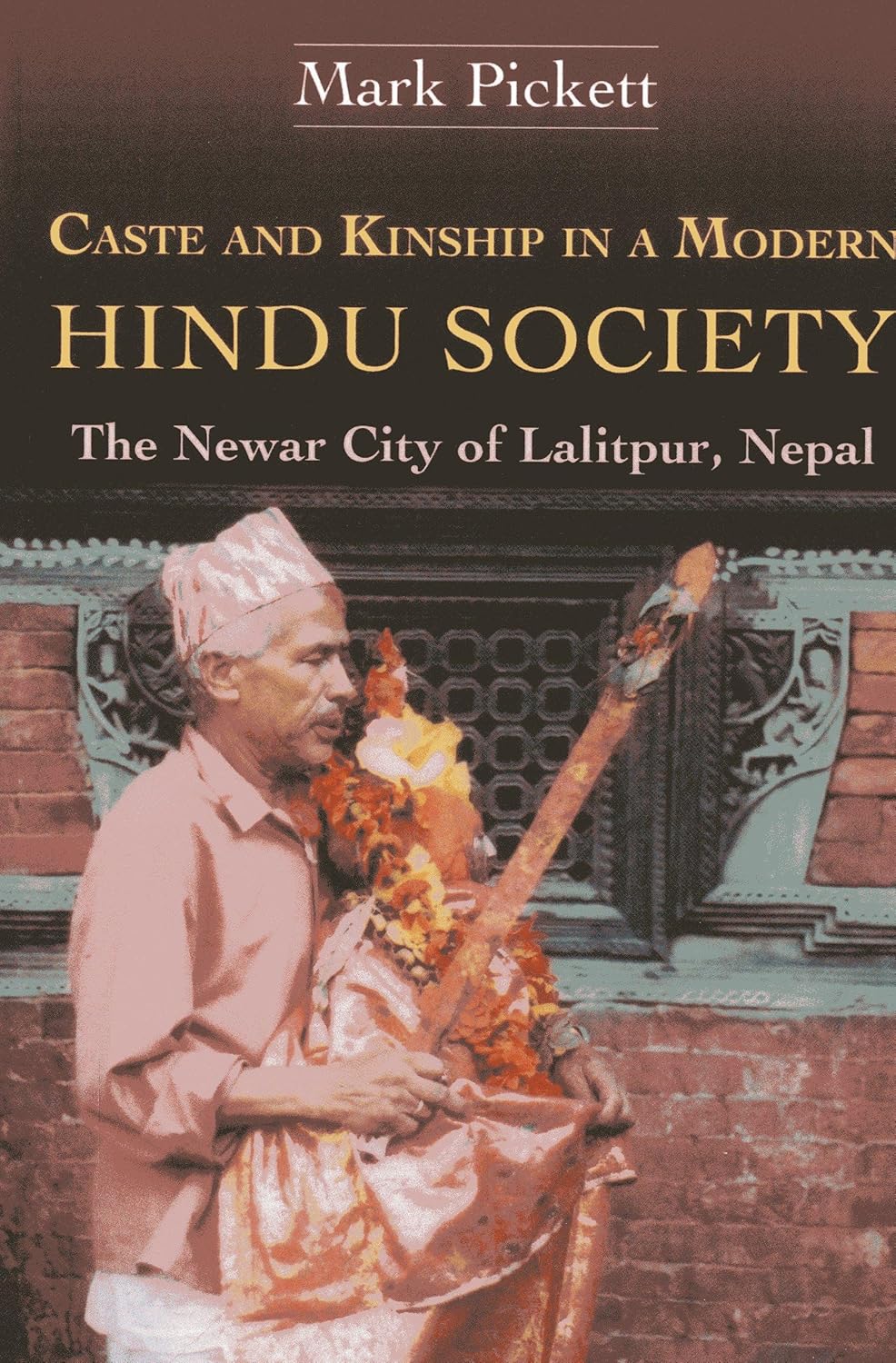
My publisher forgot to include the glossary to my book, Caste and Kinship in a Modern Hindu Society: The Newar City of Lalitpur, Nepal (Bangkok: Orchid, 2013, available here) so here it is for anyone struggling their way through it.
Apart from English terms, all
names and terms are transliterated from Newari, Nepali (Np.) or Sanskrit
(Skt.).
ācārya (ācāḥ)—learned teacher
āgã chẽ—Tantric
shrine
āgã dyaḥ—god that
resides in āgã chẽ
agnate—patrilineal kin, a person
that is related to ego through links with males alone
aĩta—sweet
presented as part of ritual gift-giving
Aji—midwife; provides ritual
service at Birth Purification
Ajimā (Hāriti)—malevolent goddess
Ashtamātrika—Eight Mother
Goddesses
ashtami—Eighth day
of lunar fortnight; important for Buddhists
avatār—‘avatar’;
incarnation of Vishnu
Awāle—Potter
aylaḥ—spirits,
usually distilled from rice
bāhāḥ, bahi—Buddhist monastery
baigaḥ—uppermost
storey of house
bājã—particular
style of traditional music; music in general
baji—beaten
rice, staple at feasts
Bāl Kumāri—one of the Eight
Mother Goddesses
bali—sacrifice,
usually animal
Banepa—small Newar town east of
Bhaktapur
Bārāhi—lineage of Carpenters; one
of the constituent thars of the Pengu
Daḥ
Bhairava—blood-accepting, male
deity; consort of the Devi
bhakta—devotee
(usually in context of Vaishnavite sects)
bhajan—hymn
Bhimsen (Bhindyaḥ)—blood-accepting,
male deity beloved of traders
bhincā macā—sister’s
son and his children
bhoto (Np.)—waistcoat
or vest of Bῦgadyaḥ
bhujyaḥ—offering to
Bῦgadyaḥ
bhutu—hearth
bhway—feast
bodhisattva—one who
aims to become a fully enlightened Buddha
Brahman—a member of a particular
lineage with links to the priesthood
brahman—the
uppermost of the four ideal varna
categories; priest
Bhaktapur—Newar city, east of
Lalitpur
bhusyāḥ—large
cymbals
bhut/pret—ghost,
malevolent spirit
buddhamārgi—a follower
of the path of Buddha; one who has a Vajrācārya domestic priest
Bῦgadyaḥ (coll.)—the god of Bῦga;
Karunāmaya/Matsyendranāth
caḥre—the
fourteenth day of the waning fortnight, especially sacred to the worship of
Shiva.
caitya—votive
Buddhist shrine; like a stupa but
much smaller
cāku—molasses
Cākwāḥdyaḥ (a.k.a. Minnāth)—accompanies
Bῦgadyaḥ on the Jātrā
Caturmāsa—period of four months
of Vishnu’s sleep
chẽ—house
cheli—ground
floor of house
chwāsā—Remains
Deity marked by an aniconic stone embedded in the ground
chwaylā bhu—pre-purification
feast
cibhāḥ—(see caitya)
Citrakār—Painter
cuka—courtyard
cusyāḥ—small
cymbals, accompany naykhĩ
cwatã—second
floor of house
dakshina—ritual fee
dabu—dance
platform
daḥmā—the main
forward beam of the chariot
dāmaru (dabu dabu)—small, one-handed
double-headed drum
dān—inauspicious
gift
dāphā—a genre of
traditional Newar music
darshan—view of the
deity; obeisance
dasa karma—Ten Life-Cycle
Rituals (see samskāra)
Dashmahāvidya—Ten Great
Knowledges; a set of female protective deities
dekhā—Tantric initiation
devi—goddess;
refers to all goddesses or specifically to the great Goddess (the Devi)
Dewāli—season for Lineage Deity
Worship
dhāḥ—two-headed
drum, may be played with wooden stick
dharma—religious
duty, law, custom, classically set out in sacred texts (dharmashastra); by extension, moral order more generally
dhimay—double
headed drum, played with hand and curved cane stick; bigger than dhāḥ
dholi
(Np.)—palanquin
digu dyaḥ—Lineage
Deity
doti—traditional
wrap-around loincloth
dyaḥ—god
dyaḥ pālā—god
guardian; caretaker of a temple
Dyaḥlā—Fisherman/Sweeper
ekadasi—11th
day of lunar fortnight; sacred to Vaishnavites
emic—the perspective of the
insider (the opposite of etic)
galli—narrow lane
Ganesh (Ganedyaḥ)—elephant-headed
god, Shiva’s first son and god of beginnings
ghaḥ—traditional
Newar water pot
Ghaḥku—a lineage of Farmers who
act as brakemen for the Bῦgadyaḥ and Cākwāḥdyaḥ chariots
ghāt—slope,
typically adjacent to a river
ghyaḥ—clarified
butter
Gubhāju (coll.)—Vajrācārya,
Buddhist Priest
guthi (gu)—socio-religious association
guthiyār—member of a guthi
gway—areca
(betel) nut
Haluwāi (coll.)—alternative thar appellation of Sweetmaker or more
general referent of any sweetmaker
hāmwa—sesame
harmin—harmonium
hiti—water spout
Holi—important spring festival
Indra—the Vedic king of the gods
ishtadevatā—chosen
deity
jā—boiled rice
jajmān—patron
jāt/jāti—common term
for group of intermarrying lineages, or caste
jātrā—processional
festival; The Jātrā refers specifically to that of Bῦgadyaḥ
jhyāli—small
cymbals
Joshi—Astrologer
juju—king
Jyāpu (coll.)—Maharjan, Farmer
kacha—raw food
kāshyap (kāshi)-gotra—of Aryan
(Indic) ancestry
Kasāḥ (coll.)—Mulmi/Nyāchyã
Shresthas, Bronzesmiths
kaḥsi—roof
terrace
kalasha—Flask used
for sacred purposes
Kāpāli—Tailor-Musicians
Karamjit—Mahābrāhman death
specialists
Karmācārya (Acāḥju)—Tantric
priest
kartal—two-piece,
one-handed percussion instrument
Karunāmaya—name of bodhisattva Avalokiteshvara (see Bῦgadyaḥ)
Kāstakār—Carpenter (alt. to Sthāpit)
Kathmandu—capital city of Nepal;
one of three cities of medieval Nepal Valley
Kãwã—skeletal demon
kawaḥ—sub-lineage
Khadgi (Nay)—Butcher
khaḥ—palanquin
khalaḥ—lineage
khĩ—drum
Khwapa (coll.)—Bhaktapur
khya—the goblin
with the lolling red tongue
khyaḥ—field
Krishna—incarnation of Vishnu
kshatriya—second of
ideal varna categories; warriors and
kings
kuladevatā
(Np.)—Lineage Deity (see digu dyaḥ)
Kumāri—Mother Goddess; also
virgin goddess in Newar societies
Kwenādyaḥ (coll.)—Jala Vināyak;
one of the four important forms of Ganesh in the Valley
lakh—one hundred
thousand
lākha mari—sweet
presented as part of ritual gift-giving
Lakshmi—goddess of good fortune;
Vishnu’s principle wife
Lalitpur—city of Nepal
(Kathmandu) Valley south of Bāgmati River; home of Pengu Daḥ
laptyā bhway—traditional
Newar leaf-plate feast
laskus—ritual
welcome at the door of house or gate of city
lhāsā-gotra—of Tibetan
(Bodic) ancestry
Licchavi—ancient rulers of Nepal
Valley
linga—phallic
representation of Shiva
Lwahãkaḥmi (coll.)—Stonemason;
one of the constituent thars of the
Pengu Daḥ
magaḥ khĩ (Np. mādal)—small two headed drum Mahādyaḥ (Shiva)
Mahālakshmi—Mother Goddess
Maharjan—Farmer
Malla—rulers of medieval Nepal
mānā—volumetric
measure of ten handfuls or about a litre
Mānandhar—Oil Presser
mandala (mandap)—sacred diagram or platform
Marikaḥmi (coll.)—Sweetmaker; one
of the constituent thars of the Pengu
Daḥ
mashān—cremation
ground
mātã—first floor
of a house
melā—grand
festival
mhāy—tenant
mhyāy macā—daughter
and her children
Mohani (Dashaĩ)—the most
important festival of the autumn season
mridanga (Skt.; Nw. pacimā)—two-headed drum
mudrā—ritual
position of the hands
muhāli—shawm
(medieval-style oboe)
Mulmi/Nyāchyã
Shresthas—Bronzesmiths
murti—image or
form of deity
nāga—serpent
deity
Nakaḥmi—(Newar) Blacksmith
nakhaḥ—festival
nakhaḥtyā—feast
associated with a nakhaḥ
Narasimha—‘man-lion’ incarnation
of Vishnu
Nārāyana—alternative name of
Vishnu; common form in Nepal
nani—courtyard
Nāpit (Nau)—Barber
Nauni—Barber’s wife
nāyaḥ—supervisor
naykhĩ—double-headed
drum, like dhāḥ but smaller; usually
played by Butchers (Nay)
nitya pujā—daily
worship
Nyāchyã—(see Mulmi)
Panauti—small Newar town in
Banepa Valley
pāju—mother’s
brother
Pānju—priest of Bῦgadyaḥ
Parbatiyā—Nepalese of the hills
pāthi—volumetric
measure equivalent to eight mānās
Pengu Daḥ— ‘The Four Groups’; the
focus of this study
phālca—public
shelter
phuki—patrilineal
relative
pikhā lakhu—carved stone
that marks the ritual entrance to the house; Kumar
pitha (pigandyaḥ)—Power-Place
pitri—ancestor
pradakshinapātha
(Skt.)—procession route
Prahlāda—son of Hiranyakashipu;
devotee of Vishnu
prākrit—natural,
aniconic stone image
Pramānas—medieval, de-facto
rulers of Lalitpur
prasād—‘grace’;
sanctified food, flowers and sinha
distributed to worshippers in return for pujā
pujā—worship,
usually comprising offerings of fruit, flowers, vermilion, and sweets
pujāri—temple
priest
pukka—food that
has been made acceptable to eat; well cooked; more generally, solid
purohit—domestic
priest
punhi—full moon,
auspicious day especially for Buddhists
pwanga—short horn
pyākhã—dance-drama
Rādhā—Krishna’s lover
Rājbhandāri—Royal Storekeeper,
member of dominant caste
Rājopādhyāya—Newar Brahman caste
Rājkarnikār (Marikaḥmi)—Sweetmaker
Rām (Rāma)—avatar of Vishnu
Rana—rulers of Nepal from
1847-1951
sadhu (see sannyasin)—ascetic renouncer
sagã—good luck
food; two varieties-egg (khẽy) and
fish (nyā)
sāit—auspicious
time
samay baji—feast-like
meal consumed after special pujā
Samgha—Buddhist Monastic
Community
samskāra—life-cycle
rituals
Sankhu—small town north of
Bhaktapur
sãnhu (sãlhu)—first day of solar month
sannyasin—ascetic
renouncer
Sarasvati—goddess of learning,
Brahma’s wife
Shaivite—of, or pertaining to,
Shiva; worshipper of Shiva
Shah—present dynasty of Nepal
kings; descendants of Prithvi Narayan Shah
Shākya (Bare)—Goldsmiths; also
workers of silver and brass; shopkeepers; of one caste with Vajrācāryas
Shilākār (Lwahãkaḥmi)—Stonemason;
alt. thar appellation for Shilpakār
Shilpakār (Lwahãkaḥmi or Sikaḥmi)—Sculptor
shivamārgi—a follower
of the path of Shiva; one who has a Brahman priest
shudra—fourth of
ideal varna categories; servants,
slaves, labourers
Sikaḥmi (coll.)—Carpenter; one of
the constituent thars of the Pengu Daḥ
sinha—mark of
vermilion on forehead
shakti—divine
power, personified as feminine
shawm—medieval-style oboe
shrāddha—Ancestor
Worship
Shrestha—dominant Newar caste;
proper thar name of some of these
sikāḥ bhu—meal
involving ritual division of head of sacrificial animal
sinājyā myẽ—rice
transplantation song
snāna—ritual
bathing
soḥra shrāddha—Sixteen
[Day] Ancestor Worship
Sthāpit (Sikaḥmi)—Carpenter
stupa (thur)—sacred mound
Swanti (Np. Tihār)—important
late-autumnal festival
syāḥ phuki—close or
‘bone marrow’ kin
tāḥ—bells
taksāri—chief of
royal mint
Taleju—chosen deity of Malla
kings; blood-accepting female deity
Tamvaḥ (coll.)—Coppersmith; one
of the constituent thars of the Pengu
Daḥ
Tāmrakār (Tamvaḥ)—Coppersmith
tāpā phuki—distant kin
thaḥ chẽ—natal home
of married woman
thākāli—senior
male; elder
thākāli luyegu—initiation
as a thākāli
thākāli nakĩ—senior
married female
thar—surname
thāy bhu—ceremonial
dish used at a Marriage or Mock Marriage celebration
Theravāda Buddhism—form of
Buddhism found in Sri Lanka and more recently brought to Nepal
thon—homebrewed
beer
thyasaphu—biographical
entry on a legal document
trope—a word or expression used
in a figurative sense
Tulādhar—principle thar of merchant caste in Kathmandu
tulasi—sacred
basil plant; worshipped as Vishnu throughout Caturmāsa
twaḥ (Np. tol)—traditional locality
Urāy (coll.)—Tulādhar et al.
utsāva (Skt.)—festival
vaikuntha—Vishnu’s
abode
Vaishnava (Vaishnavite)—of or
pertaining to Vishnu; worshipper of Vishnu
vaishya—third of
ideal varna categories; traders
Vajrācārya—Buddhist Priest
Vārāha—the boar-avatar of Vishnu
varna—‘colour’;
system of castes in sacred texts; ideal caste structure
vermilion—mercuric sulphide; a
bright red to reddish-orange coloured powder; mixed with curd, and husked rice
it is applied with the finger to the image of the deity and thence to the
worshipper’s forehead as prasād
Vishvakarma—patron deity of
artisans
vrata—Observance
including fasting usually in devotion toward a particular deity
waḥ—lentil cake
wala pala or wala pā—sub-section of guthi
yaḥ—festival
yaḥ mari—special
rice cake especially consumed at winter solstice festival
yaḥsĩ—ceremonial
pole
yajña (homa)—Fire Sacrifice
yaksha—demon
Yama (Yamadyaḥ, Yamarāja)—the god
of the abode of the dead
Yāngwa—a lineage of Farmers who
lash the chariot together with vines
Yẽnyaḥ (Indra Jātrā)—important
late-monsoon festival