Showing posts with label Caste. Show all posts

Tuesday, December 31, 2019

Caste and Community in Confusion


This is part 2 of a two-part interaction with Frontier Mission's May/June issue on India. See part 1 here.
I find the ongoing use of “caste” as the key sociological concept for the purposes of church planting deeply problematic, as I explained in some detail in a previous publication.[1] I am not sure whether people have ignored that article or simply don’t understand it, since nobody has interacted with that article. If that article is opaque, I hope I can have a chance here to remedy that.
The question of how we classify people clearly continues to excite imaginations, as we see in the recent Patidar reservation agitation in which a dominant caste in Gujarat has attempted to get legal recognition as a downtrodden people in order to be recipients of affirmative action. In this regard I find it naïve that the author identified as, A Passionate Indian Servant can say in “Why the Community/ Caste Focus is Needed in Support of Church Planting Movements” that, “There is too much of classifying people by who we think they are, rather than who they perceive themselves to be. Identities, however, are always a product of negotiation between insiders and outsiders, so it does not make sense to try to classify everyone simply according to their self identifier. In South Asia, especially, these things are contested.
In the editorial, the significance of community is front and center: “Each of these communities will likely need a separate movement of disciple making and church planting – thereby making India the greatest challenge to world evangelization…today”.
If there are “thousands of different communities all separated by caste, language and religion,” as Rick Wood asserts in “The Only Way to Reach India Is through Movements,” then India does indeed look like the neediest country in the world in terms of church planting. But if India’s communities are not as fissiparous as it first appears, that argument collapses. It does not mean, necessarily, that India is not the greatest challenge, but it does mean that such an assertion would need to be justified on other grounds.
I wonder if part of the problem is that the research is partial and biased. Why, for instance, does A Passionate Indian Servant write that, “Typically, in an Indian city, 99% of those of Scheduled Caste or Scheduled Tribe status are able to supply their community/caste/tribe name when asked.” What about other castes? In my research in Nepal, almost everyone knew their caste – to ask someone’s jati would seem rude but to ask someone’s thar invariably resulted in an immediate and clear answer.
Likewise, Victor John, in “The Bhojpuri Movement Transforming Social Dynamics,” reports that among Bhojpuri speakers “low caste or outcast Dalits and adivasi” make up 80% of the group and the “good news has tended to more quickly enter the low caste”. Nevertheless, he writes that, “If the high caste in our area are only two percent or 10 percent of the population, that same percentage is also reflected in the churches.” I can’t see how both can be true. More likely, it would seem that indeed the Bhojpuri phenomenon is an overwhelmingly Dalit movement, as indeed A Passionate Indian Servant suggests—both the Chamar and Balmiki people are Dalit castes. So John’s claim that the “focus on language rather than caste” results in the movement touching all castes, is not established.
What exactly is caste? The aforementioned author attempts to define caste in ‘formal’ and ‘informal’ ways. But what does he mean by formal and informal? Rather than clarifying the issue, such distinctions obfuscate. One would be hard put to find any scholar making such a distinction. The great need is to define caste as it is lived and experienced. It is only when real communities are understood that social data can be useful. And that only really happens with careful, in-depth, theoretically-sensitive ethnographic observation and interaction. There is little evidence that any such research has been attempted as little ethnographic data is presented.
Is caste the same thing as community? The same writer tells us that, “In south Asia, community largely means ‘caste,’ but is more innocent sounding term and preferable to many. A South Asian community is not a voluntary association, but an ethno-linguistic hereditary group with defined boundaries within which one must marry.”
Community can, of course, be defined in any number of ways, especially in today’s climate of identity politics. Caste, however, has been the subject of intense sociological and historical analysis. The writer quotes historian Sumit Guha: ‘…the bounded, status-ranked ethnic community or ‘caste’ is a social form that frequently appears in multiethnic societies… (pp. 2–3).” But Guha also argues that castes are “geographically bounded communities”.[2] It is this geographical, or territorial, element that is largely missing in so much writing on South Asian missiology. 
Allow me to return to the Badhai, whom I discussed in my previous article. According to the JP, the Badhai are a group of peoples traditionally involved in carpentry. The JP lists five groups in India with the name Badhai: 
·      Badhai (Hindu Traditions)
·      Badhai Gandhar
·      Badhai Kharadi 
·      Badhai Konkani
The first group is located across much of north, central, and western India, the second mostly in Uttar Pradesh with many also in other Indian states as well as in Pakistan and Bangladesh, while each of the three latter groups turn out to be rather few in numbers and situated in geographically tightly circumscribed areas.
The Badhai (HT) are further divided into 25 ‘subgroups’, many of whom comprise tens of thousands of individuals, and by the look of their names seem to belong to particular places just as the latter three on the main list. We are told that these subgroups are designated as such because they constitute a “segment of a people group that probably does not need a unique church planting effort.” Why? Because “The Gospel can flow between subgroups without encountering significant barriers of understanding or acceptance.”
Although I know very little about the Badhai in India, I would hazard a guess, based on my detailed field work in Nepal, that people who identify as Badhai in India would indeed have a measure of affinity for one another. However, and this is the crucial point, I think it highly unlikely that they would intermarry at any great distance, nor have much social interaction at all, except in their own locality. My point is that they constitute a societalgroup (i.e. a mental category), not a social group, as there is little interaction between the members, except in their own localities.
If this is the case, one would surmise that the 25 subgroups of the Badhai (HT) are in the same category as the Badhai Gandhar, Badhai Kharadi, and Badhai Konkani, making 28 Badhai (HT) groups in all.[3]
Furthermore, Badhai (Muslim Traditions) are also scattered, suggesting that they too in fact constitute dozens of groups. I am speculating here but Hindu/Muslim relations being what they are in India, I would not expect any significant social interaction between the two religious groupings (though inter-religious social interaction and even marriage is not always out of the question, as my research in Nepal among Hindus and Buddhists demonstrates).
So that begs the question: Does each of these groups in every one of these locations need a distinct effort of church planting? I argue no, for the following reason: For the most part, a caste does not constitute a community. An exception to this might be Dalit castes in any particular locality, where all the people belong to a single, endogamous group. But many villages and all towns and cities are made up of dozens of castes that would rarely intermarry but, nevertheless, have cordial social and religious interaction on a daily basis. It is these villages that constitute a community. In towns and cities, the traditional community may be more on the level of neighbourhood, and it is typically multicaste. With recent rapid urbanization, caste distinctions are even less significant in daily life, as both Victor John and A Passionate Indian Servant recognise.
John does recognise the significance of the locality:
In addition, caste-focused work would be impractical [sic] in many cases. In some villages, there might be only one family from a particular caste. You can’t start a worshiping community with only one family, so you need a multicaste fellowship. We focus on reaching persons based upon their language, geography, and economic status, rather than caste, because that helps the good news to take root throughout the region, and spread.
In conclusion, I would suggest that much more attention be focussed on how various caste groups interact with each other in their villages, village clusters, town neighbourhoods, etc. It is in these interactions that true community is observed and in which gospel communication can readily proceed.


[1] Mark Pickett, “Ethnicity, Kinship, Religion and Territory: Identifying Communities in South Asia,” International Journal of Frontier Missiology 32:1 (Spring 2015): 23-36. Cited 28 May 2019. Online: https://www.ijfm.org/PDFs_IJFM/32_1_PDFs/IJFM_32_1-Pickett.pdf
[2] Sumit Guha, Beyond Caste: Identity and Power in South Asia, Past and Present (Ranikhet: Permanent Black, 2016), 71. I sense some tension in Guha’s work between the ‘tribal’ nature of caste and its territorial expression. See my review of this important book here: https://markpickett.blogspot.com/2019/06/beyond-caste-identity-and-power-in.html.

[3] Having said that, it would seem that modern politics and technology are leading to the closer integration of some such groups. See, for example, the matrimonial service TeriMeriChoice.com. Online: https://www.terimerichoice.com/badhai-matrimony. I am not aware of any research to determine how significant these changes are.

Monday, July 1, 2019

Tiki for Jai Ram

“How should we advise him?” Santosh asked Shanti. 
“I don’t know,” replied Shanti. “If he keeps the tiki, people will think he is still a good Hindu when, in fact, he has become a Christian and taken baptism. But if he doesn’t keep the traditions, he will alienate his family and the whole village!” 
No part of the Bible had yet been translated into this language of South Asiawhen Santosh and his wife, Shanti, had arrived in the area. After a few years in which they became fluent in the language and built good relationships with local people, they were ready for the task of translation. As they searched for a reliable language assistant, they eventually thought of Jai Ram, a young man who lived in a nearby village. Jai Ram had been born into a highly respected traditional Hindu Brahman family. As a child, he was taught the customs of his family and his parents hoped he would become well settled in life. They made sure he received the best education they could afford, and Jai Ram was a good student who was well liked in his community.
On graduation from the local college, Jai Ram was looking for work and so agreed to help check the first draft of the Gospel of Mark which Santosh and Shanti had translated into his native tongue. It was during this work that the story of Christ gripped him, and he decided to become his disciple. At first, declaring his new path of devotion was not problematic. 
“So long as you continue to follow our customs, babu,” his mother said, “it doesn’t matter who you worship.” 
Three years had passed. Now one of his close relatives had died, and his uncle had just visited his home to tell them. This meant that the Death Feast would soon be held in the deceased relative’s village to honour him. In that Brahman tradition, the family of the deceased hosts large feasts on the eleventh and twelfth days after the family member has died. It is believed that the more people they feed on these days the more spiritual merit accrues to the person who has died and the better the quality of life they experience in their next reincarnation.
Jai Ram was troubled. He would be expected to come to the Death Feast to show respect for his dead relative. Before the feast he would be expected to have his head shaved in the traditional fashion of a relative of the deceased, leaving a tuft of hair at the back of the head - a tiki. Could he do that now that he was a follower of Jesus? Furthermore, what should he do about the feast? Could he miss the feast without it being considered terribly disrespectful? Dishonour would be brought on his family. 
In the morning, the young man walked over to the next village and set to work on the translation as usual. Over lunch he discussed his problem with Santosh and Shanti.
“Why don’t you attend the feast but not shave your head?” suggested Santosh.
“But,” replied Jai Ram respectfully, “that would be even worse than not going at all, as it would be showing disregard for an important part of our traditions.”
“Then why don’t you just have a barber shave your wholehead and not leave a tiki?” asked Shanti. “That way everyone will realize you are not a Hindu anymore because you won’t have a tiki.
“But there is nothing in the Bible condemning keeping the tiki, is there?” asked Jai Ram.
“True,” said Santosh, “but doesn’t the Bible tell us to avoid even the appearance of wrong? What I am inside should match what I am outside.”
“What about any other rituals?” asked Santosh. “The head shaving is just the preliminary part. Won’t you also be expected to join the others at the ‘holy area’ by the pond, where the priest reads from the Hindu scriptures, and offer flowers, incense and sweets to the gods?” 
“I know,” sighed Jai Ram, “and my family would be very unhappy with me if I bring shame on them by not participating.”
“Could you go along to the feast but skip being involved in any rituals?” asked Shanti.
“Of course, being there and taking part in the feast is the main thing,” replied Jai Ram. “I could try to explain that I can’t take part in the actual religious rituals. But nobody’s done that before. There is bound to be opposition. It will look like I don’t respect my elders.”
“Look, we’ll pray about it tonight and we’ll talk about it again in the morning, Jai Ram brother,” said Santosh.
That evening, as Jai Ram wandered back to the village, he agonized about what he should do. He remembered that even the apostle Paul had shaved his head (Acts 18:18). He wondered what he could do without compromising his own convictions and conscience. To make it more complicated, however, the following week, he was scheduled to give some instruction to a group of new believers from a Hindu background. They would be sure to realize what he had done, when he turned up with just a few days’ hair growth. Maybe they would thinkhe had compromised his faith even if his conscience was clear. Would this cause some of them to stumble in their faith?
Santosh and Shanti also discussed the situation late into the evening. They realized this decision also had repercussions for them. If Jai Ram upset everyone in the village by his actions the villagers would assume they had instructed him that he should not follow their customs. Would this ruin their relationship with the village and discredit their work? On the other hand, if he did indeed shave his head in the traditional way and this became known among believers in the nearby town, would it ruin the relationship and trust they had with other believers and church leaders?
There was no easy answer. Santosh and Shanti agreed that the issue really came down to the significance of the head shaving and tiki, and that of the feast. In the morning, they would walk over to the village, go over the biblical principles with him and see what he did.

Friday, June 28, 2019

Beyond Caste: Identity and Power in South Asia, Past and Present, by Sumit Guha: a Review

Beyond Caste: Identity and Power in South Asia, Past and Present, by Sumit Guha, Ranikhet: Permanent Black, 2016 (Leiden: EJ Brill, 2013), pp. 291 + xxiii.


In the course of my research in Nepal I read a lot about caste. Caste is typically understood to be the characteristic social order of India and its neighbours. Debates about what makes it what it is abound. Researchers and theorists approach it from various angles: sociological, historical, political, economic, religious.
My study on the city of Lalitpur in Nepal was largely a sociological one depending heavily on my ethnographic methodology. I did, however, do a fair bit of historical investigation, by delving into the way groups had evolved over the centuries. I was disappointed that my publisher, Orchid Press, decided to entitle my work Caste and Kinship in a Modern Hindu Society because much of what I discovered was of more historical interest. Indeed, I argued that the ritual complex of the city told us a lot about how the city wasin days gone by, rather than what it is today. (Orchid Press, by the way, has not responded to any of my attempts at communication since the book was published and I have never received a single penny in royalties.) 
In Beyond Caste, Sumit Guha delves assiduously into previously unresearched historical material and interacts with nearly all the significant literature (though not all – see below). Replete in historical and geographical detail, it is a piece of serious scholarship that deserves careful reading. I will not attempt a thorough review here but merely state Guha’s thesis, note some significant historical facts that were new to me, and make some brief comments. (For a more comprehensive review please see that of H. L. Richard here. I was given a copy of the South Asian edition. The European and American editions are a ridiculous price.)
Guha argues that a caste is a “bounded social group demarcated by the exercise of power throughout its millennial history” (252). He reminds us that, in the study of caste, the exotic has often been highlighted over aspects that are shared with other social systems. In this way, then, caste became an Orientalist trope, as did so many other aspects of Hindu culture. Guha’s point is to demonstrate that “the bounded, status-ranked ethnic community or ‘caste’ is a social form that frequently appears in multi-ethnic societies” (3).
It is not that it is exactly like that of other societies because “in South Asia it became a highly involuted, politicised form of ethnic ranking shaped by the constant exercise of socio-economic power.” And that encapsulates Guha’s answer to the big question that emerges in all the good studies of caste: to what extent is caste in South Asia unique? In my study, I argue that caste is indeed unique because of the creative tension that arises from the competing demands of centralizing kingship and decentralizing kinship, but more on that below.
One of the strengths of Guha’s study is its historical approach, focussing as it does on “dynamic social processes” (6). But it is also valuable because he does not focus on the development of caste in just one part of India. He demonstrates, rather, how social processes have gone on in different parts of the subcontinent at different rates, are often not completed, and often set in reverse; he eschews an evolutionist theoretical position which deems certain systems as necessarily primitive.
In all the vicissitudes of history, however, “the bounded ethnic group remained and remains a powerful presence” (7).
Guha, rightly, after Nicholas Dirks and Susan Bayly, argues that caste is not a product of a single ‘Hindu’ ideology. I also argued that caste is structural rather than ideological. Rather, says Guha, power is the all-important ingredient.
Guha argues that castes are a sort of tribe, by which he means “large, stratified, socio-political organizations characterized by diffuse authority and collective leadership such as, for example, a council of important chiefs” (71). He says that such “identity-centred and geographically bounded communities” were “the domains in which ethnic politics was formed” and that this gives us a “deeper appreciation of how indigenous states in India grew out of and reproduced the lasting structures of inequality so inadequately captured by what has been called the ‘caste system’” (99).
Kinship is far from the fixed, bounded unit of social organization that we often see portrayed in the literature: “kinship and exclusion from the kin were both socially constructed statuses, and a person could move from one to the other in the course of a lifetime” (150). And yet, as my research seems to suggest, there are times when kinship groups do indeed attempt to maintain a tighter boundary. 
How did caste develop under British rule? Guha reports how important the colonial administration of British India was in the formation of South Asian identities. Bernard Cohn and Nicholas Dirks, he reports, “argued that colonialism was more than a system of power: it was also a mode of knowing that constructed its objects of knowledge” 174). The colonial administration created a significant apparatus to classify and count all the peoples in its domain. Sometimes administrators visited a region and, working with local Brahman literati, as in the Bombay Presidency at the beginning of the nineteenth century, “simply divided the people into Muslims and Hindus, and the latter into Brahman, Rajput, ‘Shoodruh’ or Maratha, and Ati-Shudra or outcastes” (201), masking and distorting a much more complex reality on the ground. Interestingly, twenty years later, in the mid-nineteenth century a change had occurred, with the “basic ordering seems to have been religious (201). This would seem to correlate with the developing notions of religion in the emerging paradigm of ‘world religions’.
After the great anti-colonial uprising of 1857-8 the notion of race became a significant category in a way it had not been hitherto (203). And this was a surprise to me: by the late eighteenth century, “It was the political value of this sense of European-born identity that…led the [East India] Company to assiduously limit the development of a local power elite with any genealogical depth. It also caused the Company to discourage the immigration of non-official Englishmen into India. All this was designed…to pre-empt any local claim to the ‘rights of Englishmen’ that had just been forcefully raised in North America. The disavowed India-born offspring formed a socially inferior class of Eurasians, excluded from power” (218). In order to encourage English officials to return to Britain once their term of service was complete, Lord Cornwallis, the then Governor-General of India, sanctioned a large pay increase, allowing them to return at middle age with a substantial nest egg.
Returning to his main point, Guha tells us to “abandon the futile search for a social essence” because “social structures, old and new, have been politically ordered in ways that we cannot grasp unless we deploy the concept of caste as a bounded corporate body shaped by socio-political power throughout its long history” (255).
I have a few quibbles with Guha’s analysis.

Firstly, I think he makes too much of ranking. That is, he seems to follow the standard idea that all the castes in a society are in a clear hierarchy relative to each other. He quotes Weber: “A status segregation grown into a ‘caste’ differs in its structure from a more ‘ethnic’ segregation: the caste structure transforms the horizontal and unconnected coexistences of ethnically segregated groups into a vertical social system of super- and subordination” (13).

As I demonstrated in my work, with the exception of Dalits (those formerly known to others as Untouchables) and, to a lesser extent, other impure, but not untouchable castes, such as Butchers, those vertical relations are often contested and indeterminate because of no ritual intercaste relations. Guha does acknowledge, at least, that ethnic boundaries are porous.

Secondly, although Guha examines caste throughout traditional India (including the territories now Pakistan and Bangladesh), dividing it helpfully into five regions, and makes several references to caste in Sri Lanka, he barely mentions Nepal. In a sense Nepal is little different from other parts of the subcontinent, especially in the old Mithila kingdoms of the southern plains (Tarai). But the Newar former kingdoms of the Kathmandu Valley – Kathmandu, Lalitpur (Patan), and Bhaktapur – are particularly significant exemplars of archaic caste systems because the Nepal Valley was never under Mughal or British rule.

Although he does indeed discuss the phenomenon of kingship, and interacts with Dirks and A. M. Hocart, he doesn’t even reference Declan Quigley’s important theoretical work, The Interpretation of Caste. Thus, in my opinion, kingship and the city are not given their due.
Has Guha’s study led me to change my view of caste? Not a lot. But it has broadened it. Guha’s careful elucidation of the ongoing centrality of power in the development of caste society is convincing. In so arguing, Guha is stating that caste is not unique but is, rather, a South Asian example of political realities found in every society, but in a way that previous materialist writers had not managed.
However, Guha makes no mention at all of the ‘climax communities’ of the Kathmandu Valley. I think that is a failing. In so doing he misses the centrality of kingship in those societies. But his central thesis is solid, and I now think such cities must be regarded not as the apex of caste society but as perhaps caste's most complex instantiation.

There are missiological implications to this analysis, but more on that later.

Friday, February 13, 2015

More Thoughts on 40 'Unreached' Places

Missions researcher Justin Long recently produced a list of the 40 global districts that are the most 'unreached'. I posted some thoughts on this list already. Here are some more.

4. Social Organization


Dense populations give rise to complex social organizations. This is so of necessity as so many people living in close proximity need to structure their relations tightly to make life liveable and enable society to function. The people in these 40 provinces, then, highly value the group as opposed to the individual. They are collectivist places, where few make a decision without looking sideways to see what their significant others think. Individuals are often not even in a position to make decisions for themselves anyway. A parent (even for an adult), a brother or a husband may be the decision-maker. There is no question of making up one's own mind for such people. Issues of ultimate allegiance can be perceived very strongly as constituting a threat to the very existence of the group, or even society as a whole, making the consideration of such a change a very serious thing indeed. Paul Hiebert and his daughter Eloise Hiebert Meneses consider social organization to be of such importance that they structured an entire book on church planting around social categories.

Serious study of social organization is absolutely essential to understanding the host communities among whom one is working. And it is important on a strategic level too. I have written an article ("Recasting Evangelization Ethnicity, Kinship, Religion and Territory: Identifying Communities in South Asia") which challenges the way the Joshua Project (and other such lists) handles the phenomenon of caste. The caste system (which is the social structure of South Asia and thereby of many of these provinces) is exceedingly complex and the sociological interpretation of caste highly contentious. Suffice it to say that in my article I argue that single castes groups such as Potters do not constitute a community and therefore should not be considered the strategically significant entity.

5. Cities


One might be forgiven for thinking that the great cities found in many of the 40 provinces, such as Delhi, Kolkata, Karachi, Dhaka and Beijing, are the product of recent modernization. But this would be far from the truth, although modernization and globalization have massively increased their size. These cities are the product of centuries of development that would not be possible were it not for the four phenomena I have outlined above. Cities are the cultural product of societies that have an excess of food to requirement, which can be traded and taxed and used to support large numbers of people who are not directly involved in food production. These are therefore free to innovate, organize others, create art, explore science, and develop systems of ideas, myths and rituals to make sense of it all.

Furthermore, the biggest migration in human history is going on right now in the massive move to the cities as the world's emerging economies like India and China increasingly become major players in the global market place. The cities in these provinces, then, have become places of enormous human suffering as well as amazing openness to the gospel. Sadly, however, missions have often been slow to adjust to this momentous shift. Today's gospel messengers must focus on the cities, and be serious to address the multiple needs of the urban poor who have flocked to form their great bastis and shanty towns. The quiet rural life, for most of this century's gospel messengers, is not an option.

6. Religion and Culture


These provinces are most significant, then, as the cradles of the great global systems we call the 'world religions'. Though Islam was birthed in the desert a very high percentage of the world's Muslims are found in these 40 places. Likewise for Hindus and Buddhists. These places, then, are the great bastions of the three great religious systems that have traditionally been perceived by Christian missions as massive obstacles for their message. Moreover, efforts to differentiate between culture and religion in these places, in the hope that one might accept the one while rejecting the other, prove exceedingly complex and ultimately unsatisfying as so often the one turns out to be the flip side of the other.

As in the need to learn the host community's history the importance of in-depth understanding of their religion and culture cannot be overstated. It is only as the religious and cultural context is understood that careful contextualization of the gospel can be possible. This will inevitably lead to conflict as many Christians are not interested in such knowledge, preferring what they call the 'simple gospel'. Although I rejoice that such people are serious about sharing the Good News of Christ, I cannot but be deeply concerned for the long term health of any movement to Christ that emerges from such ministry.

Wednesday, May 28, 2014

Glossary to Caste and Kinship in a Modern Hindu Society

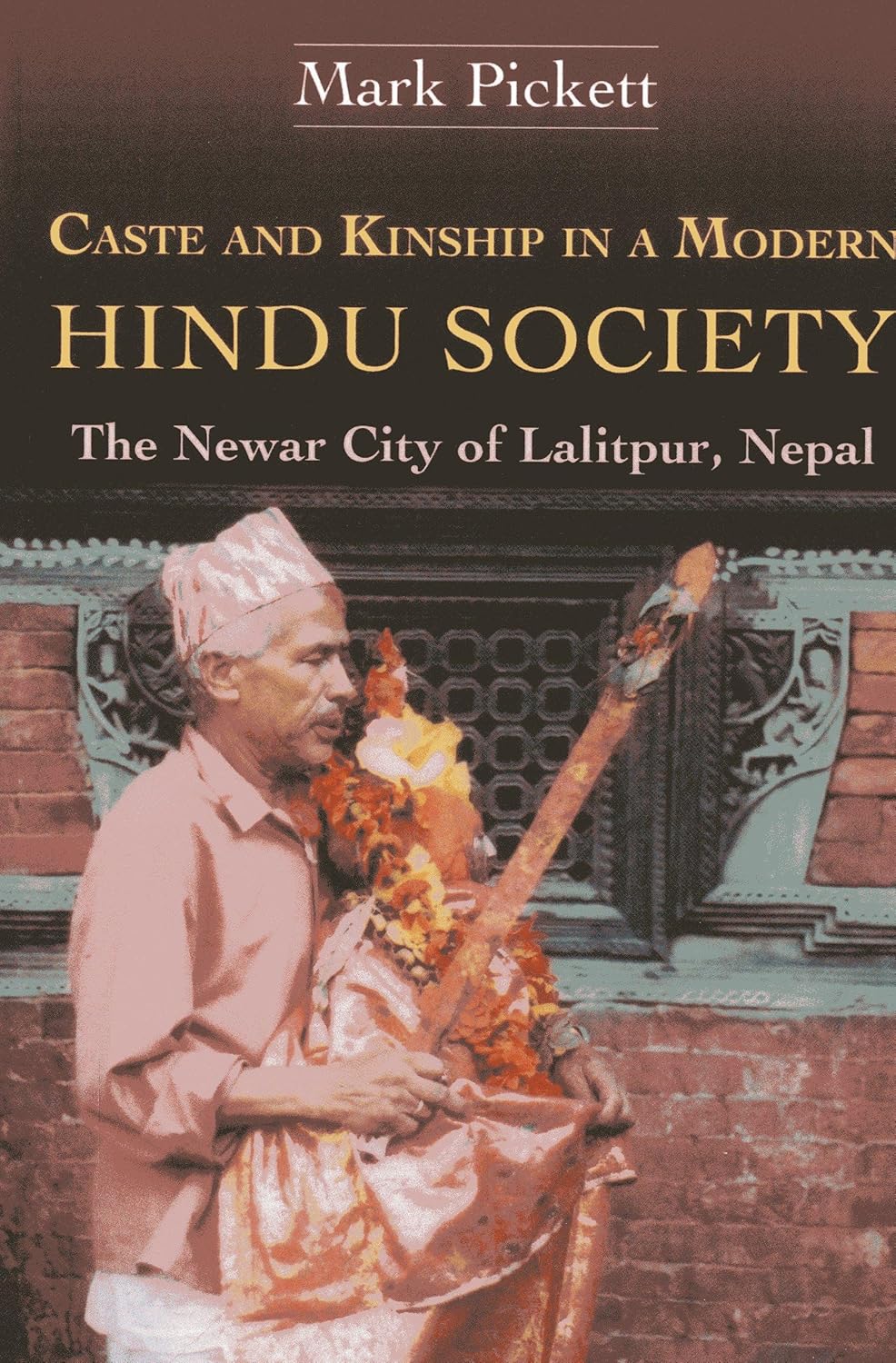
My publisher forgot to include the glossary to my book, Caste and Kinship in a Modern Hindu Society: The Newar City of Lalitpur, Nepal (Bangkok: Orchid, 2013, available here) so here it is for anyone struggling their way through it.


Apart from English terms, all names and terms are transliterated from Newari, Nepali (Np.) or Sanskrit (Skt.).

ācārya (ācāḥ)—learned teacher
āgã chẽ—Tantric shrine
āgã dyaḥ—god that resides in āgã chẽ
agnate—patrilineal kin, a person that is related to ego through links with males alone
aĩta—sweet presented as part of ritual gift-giving
Aji—midwife; provides ritual service at Birth Purification
Ajimā (Hāriti)—malevolent goddess
Ashtamātrika—Eight Mother Goddesses
ashtami—Eighth day of lunar fortnight; important for Buddhists
avatār—‘avatar’; incarnation of Vishnu
Awāle—Potter
aylaḥ—spirits, usually distilled from rice
bāhāḥ, bahi—Buddhist monastery
baigaḥ—uppermost storey of house
bājã—particular style of traditional music; music in general
baji—beaten rice, staple at feasts
Bāl Kumāri—one of the Eight Mother Goddesses
bali—sacrifice, usually animal
Banepa—small Newar town east of Bhaktapur
Bārāhi—lineage of Carpenters; one of the constituent thars of the Pengu Daḥ
Bhairava—blood-accepting, male deity; consort of the Devi
bhakta—devotee (usually in context of Vaishnavite sects)
bhajan—hymn
Bhimsen (Bhindyaḥ)—blood-accepting, male deity beloved of traders
bhincā macā—sister’s son and his children
bhoto (Np.)—waistcoat or vest of Bῦgadyaḥ
bhujyaḥ—offering to Bῦgadyaḥ
bhutu—hearth
bhway—feast
bodhisattva—one who aims to become a fully enlightened Buddha
Brahman—a member of a particular lineage with links to the priesthood
brahman—the uppermost of the four ideal varna categories; priest
Bhaktapur—Newar city, east of Lalitpur
bhusyāḥ—large cymbals
bhut/pret—ghost, malevolent spirit
buddhamārgi—a follower of the path of Buddha; one who has a Vajrācārya domestic priest
Bῦgadyaḥ (coll.)—the god of Bῦga; Karunāmaya/Matsyendranāth
caḥre—the fourteenth day of the waning fortnight, especially sacred to the worship of Shiva.
caitya—votive Buddhist shrine; like a stupa but much smaller
cāku—molasses
Cākwāḥdyaḥ (a.k.a. Minnāth)—accompanies Bῦgadyaḥ on the Jātrā
Caturmāsa—period of four months of Vishnu’s sleep
chẽ—house
cheli—ground floor of house
chwāsā—Remains Deity marked by an aniconic stone embedded in the ground
chwaylā bhu—pre-purification feast
cibhāḥ—(see caitya)
Citrakār—Painter
cuka—courtyard
cusyāḥ—small cymbals, accompany naykhĩ
cwatã—second floor of house
dakshina—ritual fee
dabu—dance platform
daḥmā—the main forward beam of the chariot
dāmaru (dabu dabu)—small, one-handed double-headed drum
dān—inauspicious gift
dāphā—a genre of traditional Newar music
darshan—view of the deity; obeisance
dasa karma—Ten Life-Cycle Rituals (see samskāra)
Dashmahāvidya—Ten Great Knowledges; a set of female protective deities
dekhā—Tantric initiation
devi—goddess; refers to all goddesses or specifically to the great Goddess (the Devi)
Dewāli—season for Lineage Deity Worship
dhāḥ—two-headed drum, may be played with wooden stick
dharma—religious duty, law, custom, classically set out in sacred texts (dharmashastra); by extension, moral order more generally
dhimay—double headed drum, played with hand and curved cane stick; bigger than dhāḥ
dholi (Np.)—palanquin
digu dyaḥ—Lineage Deity
doti—traditional wrap-around loincloth
dyaḥ—god
dyaḥ pālā—god guardian; caretaker of a temple
Dyaḥlā—Fisherman/Sweeper
ekadasi—11th day of lunar fortnight; sacred to Vaishnavites
emic—the perspective of the insider (the opposite of etic)
galli—narrow lane
Ganesh (Ganedyaḥ)—elephant-headed god, Shiva’s first son and god of beginnings
ghaḥ—traditional Newar water pot
Ghaḥku—a lineage of Farmers who act as brakemen for the Bῦgadyaḥ and Cākwāḥdyaḥ chariots
ghāt—slope, typically adjacent to a river
ghyaḥ—clarified butter
Gubhāju (coll.)—Vajrācārya, Buddhist Priest
guthi (gu)—socio-religious association
guthiyār—member of a guthi
gway—areca (betel) nut
Haluwāi (coll.)—alternative thar appellation of Sweetmaker or more general referent of any sweetmaker
hāmwa—sesame
harmin—harmonium
hiti—water spout
Holi—important spring festival
Indra—the Vedic king of the gods
ishtadevatā—chosen deity
—boiled rice
jajmān—patron
jāt/jāti—common term for group of intermarrying lineages, or caste
jātrā—processional festival; The Jātrā refers specifically to that of Bῦgadyaḥ
jhyāli—small cymbals
Joshi—Astrologer
juju—king
Jyāpu (coll.)—Maharjan, Farmer
kacha—raw food
kāshyap (kāshi)-gotra—of Aryan (Indic) ancestry
Kasāḥ (coll.)—Mulmi/Nyāchyã Shresthas, Bronzesmiths
kaḥsi—roof terrace
kalasha—Flask used for sacred purposes
Kāpāli—Tailor-Musicians
Karamjit—Mahābrāhman death specialists
Karmācārya (Acāḥju)—Tantric priest
kartal—two-piece, one-handed percussion instrument
Karunāmaya—name of bodhisattva Avalokiteshvara (see Bῦgadyaḥ)
Kāstakār—Carpenter (alt. to Sthāpit)
Kathmandu—capital city of Nepal; one of three cities of medieval Nepal Valley
Kãwã—skeletal demon
kawaḥ—sub-lineage
Khadgi (Nay)—Butcher
khaḥ—palanquin
khalaḥ—lineage
khĩ—drum
Khwapa (coll.)—Bhaktapur
khya—the goblin with the lolling red tongue
khyaḥ—field
Krishna—incarnation of Vishnu
kshatriya—second of ideal varna categories; warriors and kings
kuladevatā (Np.)—Lineage Deity (see digu dyaḥ)
Kumāri—Mother Goddess; also virgin goddess in Newar societies
Kwenādyaḥ (coll.)—Jala Vināyak; one of the four important forms of Ganesh in the Valley
lakh—one hundred thousand
lākha mari—sweet presented as part of ritual gift-giving
Lakshmi—goddess of good fortune; Vishnu’s principle wife
Lalitpur—city of Nepal (Kathmandu) Valley south of Bāgmati River; home of Pengu Daḥ
laptyā bhway—traditional Newar leaf-plate feast
laskus—ritual welcome at the door of house or gate of city
lhāsā-gotra—of Tibetan (Bodic) ancestry
Licchavi—ancient rulers of Nepal Valley
linga—phallic representation of Shiva
Lwahãkaḥmi (coll.)—Stonemason; one of the constituent thars of the Pengu Daḥ
magaḥ khĩ (Np. mādal)—small two headed drum Mahādyaḥ (Shiva)
Mahālakshmi—Mother Goddess
Maharjan—Farmer
Malla—rulers of medieval Nepal
mānā—volumetric measure of ten handfuls or about a litre
Mānandhar—Oil Presser
mandala (mandap)—sacred diagram or platform
Marikaḥmi (coll.)—Sweetmaker; one of the constituent thars of the Pengu Daḥ
mashān—cremation ground
mātã—first floor of a house
melā—grand festival
mhāy—tenant
mhyāy macā—daughter and her children
Mohani (Dashaĩ)—the most important festival of the autumn season
mridanga (Skt.; Nw. pacimā)—two-headed drum
mudrā—ritual position of the hands
muhāli—shawm (medieval-style oboe)
Mulmi/Nyāchyã Shresthas—Bronzesmiths
murti—image or form of deity
nāga—serpent deity
Nakaḥmi—(Newar) Blacksmith
nakhaḥ—festival
nakhaḥtyā—feast associated with a nakhaḥ
Narasimha—‘man-lion’ incarnation of Vishnu
Nārāyana—alternative name of Vishnu; common form in Nepal
nani—courtyard
Nāpit (Nau)—Barber
Nauni—Barber’s wife
nāyaḥ—supervisor
naykhĩ—double-headed drum, like dhāḥ but smaller; usually played by Butchers (Nay)
nitya pujā—daily worship
Nyāchyã—(see Mulmi)
Panauti—small Newar town in Banepa Valley
pāju—mother’s brother
Pānju—priest of Bῦgadyaḥ
Parbatiyā—Nepalese of the hills
pāthi—volumetric measure equivalent to eight mānās
Pengu Daḥ— ‘The Four Groups’; the focus of this study
phālca—public shelter
phuki—patrilineal relative
pikhā lakhu—carved stone that marks the ritual entrance to the house; Kumar
pitha (pigandyaḥ)—Power-Place
pitri—ancestor
pradakshinapātha (Skt.)—procession route
Prahlāda—son of Hiranyakashipu; devotee of Vishnu
prākrit—natural, aniconic stone image
Pramānas—medieval, de-facto rulers of Lalitpur
prasād—‘grace’; sanctified food, flowers and sinha distributed to worshippers in return for pujā
pujā—worship, usually comprising offerings of fruit, flowers, vermilion, and sweets
pujāri—temple priest
pukka—food that has been made acceptable to eat; well cooked; more generally, solid
purohit—domestic priest
punhi—full moon, auspicious day especially for Buddhists
pwanga—short horn
pyākhã—dance-drama
Rādhā—Krishna’s lover
Rājbhandāri—Royal Storekeeper, member of dominant caste
Rājopādhyāya—Newar Brahman caste
Rājkarnikār (Marikaḥmi)—Sweetmaker
Rām (Rāma)—avatar of Vishnu
Rana—rulers of Nepal from 1847-1951
sadhu (see sannyasin)—ascetic renouncer
sagã—good luck food; two varieties-egg (khẽy) and fish (nyā)
sāit—auspicious time
samay baji—feast-like meal consumed after special pujā
Samgha—Buddhist Monastic Community
samskāra—life-cycle rituals
Sankhu—small town north of Bhaktapur
sãnhu (sãlhu)—first day of solar month
sannyasin—ascetic renouncer
Sarasvati—goddess of learning, Brahma’s wife
Shaivite—of, or pertaining to, Shiva; worshipper of Shiva
Shah—present dynasty of Nepal kings; descendants of Prithvi Narayan Shah
Shākya (Bare)—Goldsmiths; also workers of silver and brass; shopkeepers; of one caste with Vajrācāryas
Shilākār (Lwahãkaḥmi)—Stonemason; alt. thar appellation for Shilpakār
Shilpakār (Lwahãkaḥmi or Sikaḥmi)—Sculptor
shivamārgi—a follower of the path of Shiva; one who has a Brahman priest
shudra—fourth of ideal varna categories; servants, slaves, labourers
Sikaḥmi (coll.)—Carpenter; one of the constituent thars of the Pengu Daḥ
sinha—mark of vermilion on forehead
shakti—divine power, personified as feminine
shawm—medieval-style oboe
shrāddha—Ancestor Worship
Shrestha—dominant Newar caste; proper thar name of some of these
sikāḥ bhu—meal involving ritual division of head of sacrificial animal
sinājyā myẽ—rice transplantation song
snāna—ritual bathing
soḥra shrāddha—Sixteen [Day] Ancestor Worship
Sthāpit (Sikaḥmi)—Carpenter
stupa (thur)—sacred mound
Swanti (Np. Tihār)—important late-autumnal festival
syāḥ phuki—close or ‘bone marrow’ kin
tāḥ—bells
taksāri—chief of royal mint
Taleju—chosen deity of Malla kings; blood-accepting female deity
Tamvaḥ (coll.)—Coppersmith; one of the constituent thars of the Pengu Daḥ
Tāmrakār (Tamvaḥ)—Coppersmith
tāpā phuki—distant kin
thaḥ chẽ—natal home of married woman
thākāli—senior male; elder
thākāli luyegu—initiation as a thākāli
thākāli nakĩ—senior married female
thar—surname
thāy bhu—ceremonial dish used at a Marriage or Mock Marriage celebration
Theravāda Buddhism—form of Buddhism found in Sri Lanka and more recently brought to Nepal
thon—homebrewed beer
thyasaphu—biographical entry on a legal document
trope—a word or expression used in a figurative sense
Tulādhar—principle thar of merchant caste in Kathmandu
tulasi—sacred basil plant; worshipped as Vishnu throughout Caturmāsa
twaḥ (Np. tol)—traditional locality
Urāy (coll.)—Tulādhar et al.
utsāva (Skt.)—festival
vaikuntha—Vishnu’s abode
Vaishnava (Vaishnavite)—of or pertaining to Vishnu; worshipper of Vishnu
vaishya—third of ideal varna categories; traders
Vajrācārya—Buddhist Priest
Vārāha—the boar-avatar of Vishnu
varna—‘colour’; system of castes in sacred texts; ideal caste structure
vermilion—mercuric sulphide; a bright red to reddish-orange coloured powder; mixed with curd, and husked rice it is applied with the finger to the image of the deity and thence to the worshipper’s forehead as prasād
Vishvakarma—patron deity of artisans
vrata—Observance including fasting usually in devotion toward a particular deity
waḥ—lentil cake
wala pala or wala pā—sub-section of guthi
yaḥ—festival
yaḥ mari—special rice cake especially consumed at winter solstice festival
yaḥsĩ—ceremonial pole
yajña (homa)—Fire Sacrifice
yaksha—demon
Yama (Yamadyaḥ, Yamarāja)—the god of the abode of the dead
Yāngwa—a lineage of Farmers who lash the chariot together with vines
Yẽnyaḥ (Indra Jātrā)—important late-monsoon festival