Wednesday, August 21, 2013

Why Christian Developing Countries Are More Unequal than Others


My friend Martin Allaby is a public health doctor and researcher who has recently published the book of his PhD dissertation: Inequality, Corruption and the Church: Challenges and Opportunities in the Global Church (Oxford: Regnum, 2013) (buy here). The book is the fruit of Allaby’s research into the causes of economic inequality around the world with a view to mobilizing Christians to do something about it. When Allaby first suggested his research topic to me at the school gate in Nepal, where we were both living at the time, I must admit I was sceptical. After all, how can anyone compare very different countries around the world and come up with anything conclusive about the relation between religion and poverty? Undeterred, Allaby, who had been working in public health in poor urban neighbourhoods believed it should be possible to isolate the data in such a way that something useful may be drawn from it for church and mission to reflect on and hopefully do something about. Several years later, and back to public health in Britain, Allaby has published his findings. 
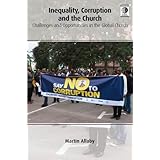
Product Details 
Allaby was, and continues to be, very concerned (as we all should be, of course) about the plight of the world’s poor. It is one thing for a doctor like him to travel with his family to serve the poor in a place like Nepal. But that wasn’t enough for Allaby. It wasn’t long before he had figured out that there wasn’t enough of him to go around and he might do more good challenging the local church to get more involved in poverty alleviation. After all, the church in Nepal was growing rapidly and should be able to take on the challenge of holistic mission.

If I remember right, Allaby thought (or was it just hoped?), naively as it turned out, that developing countries with a majority Christian and particularly Protestant population would be the least unequal economically. It wasn’t long before he discovered that the very opposite was true: economic inequality is, in fact, greatest in Christian, and especially Protestant, developing countries. How could this be? Isn’t the gospel supposed to impact the pocket of the believer as well as his soul? A careful reading of the literature, and field studies in the Philippines, Kenya, Zambia and Peru enabled him to explain this apparently incongruent fact.

What are Allaby’s conclusions? “It turns out that, although Christianity is associated with the main influences on economic inequality, it is not a significant cause of inequality in itself” (195, my emphasis). Economic inequality is greatest in countries that export raw materials, such as minerals, and where governments are large and corrupt. Many such countries have a majority population that identifies itself as Christian. How has that happened? Such countries, Allaby argues, had a pre-colonial history characterized by a relatively sparse population and unsophisticated technology, political organization and religion. This made such societies much more ready to convert to Christianity than the relatively densely populated and technologically and culturally sophisticated societies of Asia.

This problem of a high reliance on raw materials for export is often accompanied in Protestant developing countries by large and corrupt governments. These, Allaby asserts, are probably the result of colonial authorities trying to leave behind the legacy of a functioning welfare state upon independence. Corruption wasn’t controlled and state resources meant for the poor have been diverted to the ruling elite.

You might ask how it is that so many of those developing countries had sparse and technologically, and culturally unsophisticated populations. To answer that question, I would encourage you to read Jared Diamond’s Guns, Germs and Steel: A Short History of Everything for the Last 13,000 Years (London: Vintage, 1997). This fascinating book, by an evolutionary ornithologist as it happens, explains among a host of other things, how it is that the societies of sub-Saharan Africa and the Americas were so susceptible to being taken over by the colonial forces of Europe from 1492, why they had sparse populations, and why they were so ready to convert to the religion of their colonial masters. The relative technological and cultural advancement of Eurasia is largely, says Diamond, to do with the continent’s E-W orientation. (To treat Eurasia as two continents really doesn’t make sense at all and is a Eurocentric geographical construct of the first order.) The Americas and sub-Saharan Africa are oriented N-S and relatively cut off from the major cultural advances that were going on in Eurasia over the last several millennia. It is as simple as that, as Diamond argues most cogently. 


Back to Allaby: the second conclusion that Allaby draws from his data is that Christians can most readily reduce economic inequality in their countries by tackling corruption. In relatively wealthy majority Christian countries governments tend to be much less corrupt. This, says Allaby, is because they are also the countries where Christian influence has been more long-lasting. Christians in developing countries where the church is young and corruption rife need to avoid the twin evils of withdrawal from the world and such involvement in the world that they lose their distinctive character. My prayer is that Allaby’s study will be read and its message taken on board and acted on.


Monday, August 19, 2013

Preaching in the Rhondda

I drove over the hills to preach in the Rhondda yesterday. The Rhondda Valley is in fact a sort of crooked tuning-fork shaped double valley running down from the hills south of the Brecon Beacons and joining the Taff lower down. Around 60,000 people live there in tightly packed terraces running along the valley's steep sides. When coal began to be mined in Victorian times a mass migration to the valley occurred. A fruitful non-conformist movement drew many of the new arrivals into the chapels that sprang up in every community such that at one time there were 151 of them all together. Sadly, liberal theology and culture-Christianity sapped the soul out of that movement such that today there are may be a dozen mostly small, struggling chapels left. I preached at Carmel chapel in Blaenllechau to about 20 in the morning and a dozen or so in the evening. We sang a cappella (which I have just realized is quite appropriate as it means to sing in the style of the chapel). We did well for our number. No four part harmony though. I preached on Exodus 18 in the morning, on Jethro's meeting with Moses and how Moses shared the salvation of Israel with his pagan father-in-law and his wonderful response. In the evening I sought to open up Paul's letter to the Philippians as a lovely missive from the apostle to his dear partners in Philippi, the sort of partnership that was and the fruit it produced. I trust it did the church good as it did me to enjoy their fellowship for the day.

There is a huge need for faithful, hard working ministry in this valley as well as the others that make up this unusually needy urban area. We pray for the churches who press on in the face of declining numbers and are encouraged by new initiatives by the Valley Commandos (http://www.valleycommandos.com/) among others.

Thursday, July 18, 2013

Learning from Roland Allen (and Paul) Today


It is over a century now since Roland Allen, a British former missionary to China published Missionary Methods: St Paul’s or Ours? (Download a free pdf of the book here: http://ia700300.us.archive.org/35/items/missionarymethod00alle/missionarymethod00alle.pdf.) Not many books are still in print so long after their initial publication. So what makes it so significant? In this book, Allen compares Paul’s approach with those that were common at the turn of the 20th century. Contemporary methods were heavily influenced by colonial attitudes oftentimes manifesting a superior spirit towards native believers. There was a reluctance to give authority to local believers. Often it was felt that converts needed long periods of instruction before they were baptized and given membership of a church. Mission control over native churches was a given.


Although Allen was a High Churchman this does not seriously affect the expression of his missionary principles (‘Methods’ is actually a misleading title) except in perhaps one respect which we will note later. He was hot on the work of the Spirit in mission and the centrality of the Word and so his principles fit easily with a Reformed approach. He abhorred the pragmatic approach that focussed on the overwhelming difficulties in the way of establishing churches and believed that missions had failed because of obstacles that they had introduced.

Allen’s Argument


The chapters of Missionary Methods are logically arranged and seek one by one to answer the question, What was the reason for Paul’s success?
1.      Introduction.
2.      Strategic Points. Paul deliberately made the most of the administrative, linguistic, and cultural advantages available in the Roman system.
3.      Class. Paul did not have a strategy of approaching the elite of the societies he was reaching out to.
4.      Moral and Social Condition. The spiritual, moral and social condition of the first century Mediterranean world was just as corrupt as any society you will find on earth in the contemporary context. Paul had no advantage over the contemporary scene.
5.      Miracles. Paul’s miracles were significant but their significance must not be exaggerated.
6.      Finance. Allen makes three assertions concerning Paul’s use of money: (1) he did not seek financial help for himself; (2) he took no financial help to those to whom he preached; (3) he did not administer local church funds.
7.      The Substance of Paul’s Preaching. Allen draws out a number of lessons from Paul’s preaching: he was sensitive to his hearers; he didn’t blast them; he was no inclusivist; he preached the wrath of God; he did demand of them a moral and spiritual change and was not content to merely sow the seed; and finally he preached for individual change but also for social communion.
8.      The Teaching. Allen asserts that much contemporary mission work of his time teaches new believers to rely not on the Spirit but on the missionary.
9.      The Training of Candidates for Baptism and Ordination. Teaching followed baptism. This does not mean that the rite was carelessly administered. Allen concludes that Paul admitted only a few people of known reputation who showed real faith then handed over the admission procedure to those men. Likewise in the appointment of elders.
10.  Authority and Discipline. The churches were not dependent on the apostle but neither were they independent of him.
11.  Unity. The churches that Paul founded were one in spirit. Paul refused to make them one in form or structure. Allen also points out that nowhere does Paul “establish a priori tests of orthodoxy”.

In the last 3 chapters Allen seeks to apply the principles he has expounded to the contemporary situation. 

Analysis


It is impossible in a blog post to do justice to Allen’s thought. However, it is important to see how Allen both built on previous work and paved the way for later thinking on contextualization. Clearly Allen was drawing on the work of a half-century previous by Henry Venn and Rufus Anderson with their call for churches in mission situations to become indigenous. Allen’s emphasis on the work of the Spirit is refreshing and shows up the lack of theological grounds for the overbearing nature of much missionary control, at least in the past—but one wonders about situations today too.

Allen asserts that the modern missionary, like Paul, should move on from planting a church much earlier than has traditionally been the case. He must leave the new church to the care of the Spirit. Here I think Allen takes a big risk. One can certainly sympathize with this approach. The security of the new church certainly does not depend on the presence of the missionary. Still today, so many years after Allen’s thinking was published missionaries are often found to be in a situation for decades, eventually leaving a stunted and impoverished church.

But should a missionary up and leave after just a few weeks or months? Here Allen surely overstates his case. Paul, after all, often had to leave a new church not by his own choice but because he was drummed out of town, such as at Thessalonica and Berea (Acts 17). Furthermore, sometimes he did in fact choose to stay for a considerable time, as at Ephesus (Acts 19). Allen clearly has, here, misrepresented Paul. Allen’s theological contentment with leaving the new church so quickly must be found in his High Churchmanship. For Allen leaving a new church with the Sacraments for their nurture was enough. No evangelical will surely be content with that. The Lord’ commission included the injunction to teach the disciples to obey all that he had commanded them (Matt 28:20). That implies ongoing ministry, whether by the church planter or by those he has trained and equipped.

Nevertheless, Allen’s insistence that new believers have the Spirit and can therefore be confidently commended to the Lord and left without missionary control is a principle that is still as needed today as it was when he stated it.

The work of Roland Allen stands squarely in the stream of precursors to the contemporary missiological debates about contextualization. His work came out of reflection on his contemporary situation and almost a century later still deserves a careful reading.

Thursday, July 11, 2013

An Encounter with Alan Tippett (Part 2)


In my last post I addressed Tippett’s first of six problems that the evangelist of ‘animistic’ peoples needs to deal with. He has five more and taken together I think his case for treating primal peoples in a category of their own is seriously problematic.

Tippett’s second problem is the issue of motivation: “Animists may be interested in Christianity for many and varied reasons – some good, others bad”. However, this problem is universal wherever commitment to Christ is seen as a path to material gain, so it does not apply as a peculiar issue for the evangelization of primalists.

Tippett’s third problem is the issue of meaning: the message being proclaimed may be misunderstood by the hearers because of the worldview through which it is heard and received leading to all sorts of problems as Paul and Barnabas had (Acts 14:8-18). This, surely, is also universal – misunderstandings happen wherever the gospel is preached and no matter how sophisticated the community being evangelized.

Tippett’s fourth problem, social structure, likewise, is an issue in many types of society, not just those typically identified as animistic. In fact, even in complex urban societies social structure is an issue. At its most basic level family relations, marriage etc can be either an obstacle or a bridge to the spread of the message.

The issue of incorporation into the church (Tippett’s fifth problem) is linked with the issue of social structure and is certainly shared with other societies. Tippett is concerned that the proclamation of the gospel to animists is not carried on individualistically. Churches must be formed, not just isolated disciples, a given in the New Testament and one that Tippett rightly addresses, but not one that is unique to primal contexts.

Tippett’s sixth problem is the issue of cultural void. If churches are to thrive in animistic contexts they must be taught to value features of their culture that are positive rather than rejecting them all as necessarily evil. This, too, is clearly an issue in any situation where the gospel call is misunderstood as a call to abandon valid cultural activity.

So, of Tippett’s six problems I can’t recognize any that are peculiar to the evangelization of primal peoples. All this goes to demonstrate the difficulty of trying to isolate tribal peoples, or animists, or whatever we may call them as a distinct type of religion. When we look around at the peoples of the world and their religious experiences we have to recognize that we are all subject to one degree or another to primal tendencies – even missiologists! Nor are they all negative. Tippett’s six problems, then, apply to the evangelization of people of all kinds. Yet again the comparative religion project is found to be wanting.