Showing posts with label Muslim. Show all posts

Tuesday, December 31, 2019

Caste and Community in Confusion


This is part 2 of a two-part interaction with Frontier Mission's May/June issue on India. See part 1 here.
I find the ongoing use of “caste” as the key sociological concept for the purposes of church planting deeply problematic, as I explained in some detail in a previous publication.[1] I am not sure whether people have ignored that article or simply don’t understand it, since nobody has interacted with that article. If that article is opaque, I hope I can have a chance here to remedy that.
The question of how we classify people clearly continues to excite imaginations, as we see in the recent Patidar reservation agitation in which a dominant caste in Gujarat has attempted to get legal recognition as a downtrodden people in order to be recipients of affirmative action. In this regard I find it naïve that the author identified as, A Passionate Indian Servant can say in “Why the Community/ Caste Focus is Needed in Support of Church Planting Movements” that, “There is too much of classifying people by who we think they are, rather than who they perceive themselves to be. Identities, however, are always a product of negotiation between insiders and outsiders, so it does not make sense to try to classify everyone simply according to their self identifier. In South Asia, especially, these things are contested.
In the editorial, the significance of community is front and center: “Each of these communities will likely need a separate movement of disciple making and church planting – thereby making India the greatest challenge to world evangelization…today”.
If there are “thousands of different communities all separated by caste, language and religion,” as Rick Wood asserts in “The Only Way to Reach India Is through Movements,” then India does indeed look like the neediest country in the world in terms of church planting. But if India’s communities are not as fissiparous as it first appears, that argument collapses. It does not mean, necessarily, that India is not the greatest challenge, but it does mean that such an assertion would need to be justified on other grounds.
I wonder if part of the problem is that the research is partial and biased. Why, for instance, does A Passionate Indian Servant write that, “Typically, in an Indian city, 99% of those of Scheduled Caste or Scheduled Tribe status are able to supply their community/caste/tribe name when asked.” What about other castes? In my research in Nepal, almost everyone knew their caste – to ask someone’s jati would seem rude but to ask someone’s thar invariably resulted in an immediate and clear answer.
Likewise, Victor John, in “The Bhojpuri Movement Transforming Social Dynamics,” reports that among Bhojpuri speakers “low caste or outcast Dalits and adivasi” make up 80% of the group and the “good news has tended to more quickly enter the low caste”. Nevertheless, he writes that, “If the high caste in our area are only two percent or 10 percent of the population, that same percentage is also reflected in the churches.” I can’t see how both can be true. More likely, it would seem that indeed the Bhojpuri phenomenon is an overwhelmingly Dalit movement, as indeed A Passionate Indian Servant suggests—both the Chamar and Balmiki people are Dalit castes. So John’s claim that the “focus on language rather than caste” results in the movement touching all castes, is not established.
What exactly is caste? The aforementioned author attempts to define caste in ‘formal’ and ‘informal’ ways. But what does he mean by formal and informal? Rather than clarifying the issue, such distinctions obfuscate. One would be hard put to find any scholar making such a distinction. The great need is to define caste as it is lived and experienced. It is only when real communities are understood that social data can be useful. And that only really happens with careful, in-depth, theoretically-sensitive ethnographic observation and interaction. There is little evidence that any such research has been attempted as little ethnographic data is presented.
Is caste the same thing as community? The same writer tells us that, “In south Asia, community largely means ‘caste,’ but is more innocent sounding term and preferable to many. A South Asian community is not a voluntary association, but an ethno-linguistic hereditary group with defined boundaries within which one must marry.”
Community can, of course, be defined in any number of ways, especially in today’s climate of identity politics. Caste, however, has been the subject of intense sociological and historical analysis. The writer quotes historian Sumit Guha: ‘…the bounded, status-ranked ethnic community or ‘caste’ is a social form that frequently appears in multiethnic societies… (pp. 2–3).” But Guha also argues that castes are “geographically bounded communities”.[2] It is this geographical, or territorial, element that is largely missing in so much writing on South Asian missiology. 
Allow me to return to the Badhai, whom I discussed in my previous article. According to the JP, the Badhai are a group of peoples traditionally involved in carpentry. The JP lists five groups in India with the name Badhai: 
·      Badhai (Hindu Traditions)
·      Badhai Gandhar
·      Badhai Kharadi 
·      Badhai Konkani
The first group is located across much of north, central, and western India, the second mostly in Uttar Pradesh with many also in other Indian states as well as in Pakistan and Bangladesh, while each of the three latter groups turn out to be rather few in numbers and situated in geographically tightly circumscribed areas.
The Badhai (HT) are further divided into 25 ‘subgroups’, many of whom comprise tens of thousands of individuals, and by the look of their names seem to belong to particular places just as the latter three on the main list. We are told that these subgroups are designated as such because they constitute a “segment of a people group that probably does not need a unique church planting effort.” Why? Because “The Gospel can flow between subgroups without encountering significant barriers of understanding or acceptance.”
Although I know very little about the Badhai in India, I would hazard a guess, based on my detailed field work in Nepal, that people who identify as Badhai in India would indeed have a measure of affinity for one another. However, and this is the crucial point, I think it highly unlikely that they would intermarry at any great distance, nor have much social interaction at all, except in their own locality. My point is that they constitute a societalgroup (i.e. a mental category), not a social group, as there is little interaction between the members, except in their own localities.
If this is the case, one would surmise that the 25 subgroups of the Badhai (HT) are in the same category as the Badhai Gandhar, Badhai Kharadi, and Badhai Konkani, making 28 Badhai (HT) groups in all.[3]
Furthermore, Badhai (Muslim Traditions) are also scattered, suggesting that they too in fact constitute dozens of groups. I am speculating here but Hindu/Muslim relations being what they are in India, I would not expect any significant social interaction between the two religious groupings (though inter-religious social interaction and even marriage is not always out of the question, as my research in Nepal among Hindus and Buddhists demonstrates).
So that begs the question: Does each of these groups in every one of these locations need a distinct effort of church planting? I argue no, for the following reason: For the most part, a caste does not constitute a community. An exception to this might be Dalit castes in any particular locality, where all the people belong to a single, endogamous group. But many villages and all towns and cities are made up of dozens of castes that would rarely intermarry but, nevertheless, have cordial social and religious interaction on a daily basis. It is these villages that constitute a community. In towns and cities, the traditional community may be more on the level of neighbourhood, and it is typically multicaste. With recent rapid urbanization, caste distinctions are even less significant in daily life, as both Victor John and A Passionate Indian Servant recognise.
John does recognise the significance of the locality:
In addition, caste-focused work would be impractical [sic] in many cases. In some villages, there might be only one family from a particular caste. You can’t start a worshiping community with only one family, so you need a multicaste fellowship. We focus on reaching persons based upon their language, geography, and economic status, rather than caste, because that helps the good news to take root throughout the region, and spread.
In conclusion, I would suggest that much more attention be focussed on how various caste groups interact with each other in their villages, village clusters, town neighbourhoods, etc. It is in these interactions that true community is observed and in which gospel communication can readily proceed.


[1] Mark Pickett, “Ethnicity, Kinship, Religion and Territory: Identifying Communities in South Asia,” International Journal of Frontier Missiology 32:1 (Spring 2015): 23-36. Cited 28 May 2019. Online: https://www.ijfm.org/PDFs_IJFM/32_1_PDFs/IJFM_32_1-Pickett.pdf
[2] Sumit Guha, Beyond Caste: Identity and Power in South Asia, Past and Present (Ranikhet: Permanent Black, 2016), 71. I sense some tension in Guha’s work between the ‘tribal’ nature of caste and its territorial expression. See my review of this important book here: https://markpickett.blogspot.com/2019/06/beyond-caste-identity-and-power-in.html.

[3] Having said that, it would seem that modern politics and technology are leading to the closer integration of some such groups. See, for example, the matrimonial service TeriMeriChoice.com. Online: https://www.terimerichoice.com/badhai-matrimony. I am not aware of any research to determine how significant these changes are.

Frontier Missiology Goes POP


Back in the summer I wrote a response to the May-June 2019 issue of Mission Frontierswhich was titled “India: The Greatest Challenge to World Evangelization.” That didn't go anywhere so I thought it would be good to post it here in the hope that a few people at least would read it.

I rejoice that in recent decades many in India, especially from lower status groups, have come to be followers of Jesus. It is also moving to read of the persecution that many are experiencing (Enduring Persecution in India”) and the disappointments and challenges with which Andy Walker and his co-workers are attempting to deal (“A Church Planting Movement Advancing through Barriers”). 

I hope, with the editor and authors, that this issue, along with the other work of Frontier Ventures, leads to concerted prayer and engagement in making Christ known in the country.

The arguments presented in the issue are compromised, however, by two major weaknesses, which I would like to address.

Before doing so, however, I would like to point out a glaring error in “Enduring Persecution in India,” in which the ‘Leader of a Church Planting Movement in India’ asserts that when the bamboo curtain came down in China there were 70 million churchesOperation World reports that in 2010 there were 75 million evangelicals in the country, so it is highly unlikely that there were so many churches decades before. How important it is that we check and recheck our figures for accuracy before we go to print. My main concerns, however, are theological and sociological.

In this post I will deal with the first: Frontier Missiology Goes POP.

The frontier mission movement is plagued by pragmatism. This is especially apparent in Anderson's, “Embracing an Audacious God-Sized Dream,” and Walker's “A Church Planting Movement Advancing through Barriers.”

While it is good to discuss practical methods of engaging people with the gospel, pragmatism is unbecoming of God’s people. Our approach must not be to borrow strategies and frameworks from the marketing world; our philosophy of ministry must be founded on much more solid ground than expediency. 

A number of the authors do indeed refer to Scripture. But there is a difference between an approach that references a few proof texts and a theologically robust missiology that takes the grand sweep of the storyline of the Bible seriously.

Pragmatism is not a new problem in missiology. Indeed, it has plagued much missiology for decades. Take the notion of the “Persons of Peace”: How is it that one element of one narrative from one Gospel (Matt 10:11— in Luke 9:4 Jesus talks about a ‘house’—) has been so over-extended to become the centre of a whole methodology? One text is having to do an awesome amount of work.

A balanced approach would surely be to establish a sounder theological base for the great task by deriving principles from a careful exegesis of all the key New Testament passages. That is not in evidence in this issue. Which brings me to John Ridgway’s article.

In “Key Insights in Enabling Movements among the Hindu and Muslim Peoples” Ridgway interprets the “way in the wilderness” (Isa 43:19) as “new pathways in the Scriptures.” On this basis he argues that, “…from a kingdom perspective, we view everything from a spiritual framework, not a physical framework.” Why does Ridgway contrast spiritual with physical? It certainly doesn’t emerge out of the verses quoted: In Romans 12:1-2, Paul explicitly urges the Romans to offer their bodies as living sacrifices. A few verses pulled out of context don’t make a good basis for building a missiology. 

The Lord Jesus himself taught his disciples not to set up a false dichotomy between the spiritual and the physical: “Love the Lord your God with all your heart and with all your soul and with all your mind and with all your strength” (Mark 12:30). Jesus’ own incarnation is the glorious sign of the worth of the physical – a reality that continues with his resurrection and ascension in the body to the right hand of the Father. We can also be confident of the continuity not only of our personal physicality (1 Cor 15) but also that of the cosmos (Rom 8:22-25).

Though I appreciate Ridgway’s attempts to overcome the obstacles that many Hindus and Muslims find in their way, his “new pathways” seem to have led him right out of the Scriptures and down the garden path of the old gnostic heresy that dogged the early church. This will have far-reaching implications that are apparently not appreciated.

Later I will post my second concern.

Tuesday, May 28, 2019

Review Article: Outside In

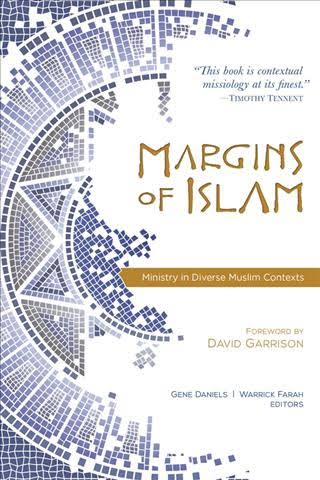
Margins of Islam: Ministry in Diverse Muslim Contexts

Edited by Gene Daniels and Warrick Farah (Pasadena: William Carey), 2018, 240pp, £12.30 (Amazon), £7.66 (Kindle)
I was in Indonesia last year, teaching in a couple of seminaries.[1] That vast archipelago constitutes the most populous Muslim-majority nation on Earth. Just a few months earlier, the country was shocked when radical Islamists (from one family as it happens) killed thirteen worshippers at Easter services in the city of Surabaya.[2] That violent extremism seemed far away from the folk I met there, such as the middle-aged hijabi who sat next to me on the long train journey across the island and offered me a share of her snacks. I also met the leader of a movement of people, outside mainstream evangelicalism, who meet regularly in small groups to read the Bible and worship Jesus. After twenty years, the movement’s leaders reckon their numbers have now reached six figures. The key feature of these vignettes for our purposes is that all these people would identify as Muslims.
Since then, I have met a number of Muslims as I have visited universities around the UK. Let me introduce some of them to you: the young Mancunian woman in her hijab, the mature Iranian man who dare not go home for fear of the state, the Algerian researcher trying to make sense of the modern world, the Egyptian postgraduate student who asked me why Christians are so private about their religion, and the young Saudi woman who told me she had rejected Wahabi Islam when she saw what IS was doing.
What staggering diversity. How do we make sense of Islam in a world of such variety? What, after all, is Islam? Is it a religion or a way of life or something else? 
This book is a major contribution to understanding Islam and ministry to Muslims. Read more here.

Thursday, April 18, 2019

Winter into Spring VIII: Muslims

In both Newcastle and Dundee, especially the latter, the events were attended by a number of Muslim students. I was struck by the diversity in this ‘community’. There was the British young lady in her hijab, the mature Iranian man who can’t go back home for fear of the state, the Egyptian post-graduate student who asked me why Christians are so reticent to be public about their religion, the young lady from a very tightly-controlled country who told me she had rejected the Wahabi interpretation of Islam when she saw what IS was doing, and the Arab student who identified as an atheist (more about him later).
Those that attended events listened respectfully and were happy to discuss the issues that arose. There were no heated arguments, no verbal attacks. On first entering the marquee they were perhaps a little uncomfortable, wondering, probably, if they were allowed. But a welcome by a student or CU guest soon put them at ease.
One leader of the Islamic Soc. in Newcastle attended a lunch bar and asked me a load of questions about the logistics of the venue, etc.: he was getting ideas for their own events week!
Another male student, from Pakistan, came during the morning slack time when the marquee was open for coffee. We had a respectful and frank exchange of views and I gave him my email if he should want to contact me later. I received an email a few weeks later apologising if he had given offence (he had not) and said he would come back to me with more questions.
The high point from the point of view of witness to Muslims, was the dialogue between an Imam and a Pastor in Dundee. Imam Jabil, a local mosque leader, shared the stage with Duncan Peters from Glasgow, with the two-hour event ably chaired by a retired Dundee lecturer. The chair had made a list of questions which he asked in turn, with each man having three minutes to answer each question. At the end, questions were fielded from the floor, with the whole event lasting two hours.
About 15 Muslim students attended as well as around the same number of CU members and a few of us others. The Arab atheist stood at the back nearly the whole time (arriving slightly late). He was clearly flabbergasted at what he was witnessing – a friendly sharing of views. He asked me who had organised the event. Afterwards he stayed to talk, not giving too much away but telling me he was unimpressed by the answers the Imam was making.
I thought this event was a modest success. The big gain for the CU is that it provided an environment for building relationships and in which the sharing of the gospel was entirely natural. It was important for those of us who organised this that the event should not be a debate but a dialogue. The former can sometimes cause people to feel threatened, leading them to become defensive and combative. Here no one felt under attack; all were happy to talk afterwards. Duncan’s fresh translation of Luke’s Gospel – Holy Injil: Luke– was available for people to take afterwards. A number of the Muslims who attended came back for subsequent events.
It would be great to see such events put on in universities throughout Europe, especially where there are a significant number of Muslim students. We need to help students to create concrete ways in which they can show love to their classmates, and in which the truth of the person of Jesus and his saving work can be shared respectfully and humanely.

Wednesday, July 19, 2017

Cross-Currents in Muslim Ministry: A Review Article of A Wind in the House of Islam

A Wind in the House of Islam: How God Is Drawing Muslims around the World to Faith in Jesus Christ, by David Garrison (Monument, Col.: WIGTake, 2014).

The House of Islam, Dar al-Islam in Arabic, is “the name Muslims give to an invisible religious
empire that stretches from West Africa to the Indonesian archipelago, encompassing 49 nations and 1.6 billion Muslims” (5). David Garrison’s thesis is that ‘a wind’ is blowing through the house: “Christianity’s re-emergence” from centuries of decline and in many cases obliteration (6).

Clearly by Garrison’s own assertion and from the many stories that are reported, this book needs to be studied by all who have an interest in the progress of the gospel in the Muslim world. If the stories and statistics are to be taken at face value there is an astonishing and unprecedented turn to Christ taking place in many locations and among many distinct communities at this time, for which we should give thanks to God. But such claims need to be critically evaluated rather than simply accepted at face value. In this review article, I want to do just that in the hope that further research will be more fruitful. I will start by outlining the book using Garrison’s headings.

Click here for the rest of this review.

Friday, February 24, 2017

Reflections on Student Ministry


Over the last month I have had the privilege of being involved in two major student events weeks, the first in Reading University and the second in Leeds University. In both I was a guest of the Christian Union ('CUG') and was a member of a team of workers from different backgrounds and from across the evangelical spectrum. I want to share some of my observations and reflections from those weeks.

Encouraging

What a blessing to be in early morning prayer meetings with scores of students enjoying the realities of the gospel and imploring the Saviour to be good to their friends. Seeing hundreds turn up to events knowing that the centrepiece was a talk about Jesus was a great joy. The good news of Jesus was central. The hard questions - Where is God when it hurts? How can a God of love send people to hell? Can we trust a book of fairy tales? etc. - were answered head on, and competently. Miracles were not seen as an embarrassment. The exclusive claims of Christ were not hedged. I had the joy of about a dozen serious conversations in each week. One or two lasted for two hours. I felt that a number of these were deeply affected by the presentations they attended. Many came back time after time. At each week several students filled out cards expressing that they had prayed with the speaker at the end of the evening. And many requested to be included in the follow up course or to go to a church. I was able to introduce most of those that I had had good conversations with to a CU member so that they were able to develop a friendship and continue their exploration of the faith.

Eye-opening

The CUs used many creative ways to attract their fellow-students to the events: the venue in both cases was a large marquee right in the centre of campus (Durham CU's experience last year seems to have been a great boost in this direction); wine and cheese; ceilidh; live acoustic music; sandwiches for lunch; full-blown meals for international students. I never felt these tactics were in any way inappropriate. There was no glorification of performers and no one suggested the CUs were tricking students to attend. One Chinese student asked why we put on such meals. I answered, "As followers of Christ we love to give hospitality and we love to talk about Jesus." At one lunchbar I did notice two students eat their sandwich and head straight out. They were by far the exception. The vast majority stayed right through the event; sometimes the formal part lasted over an hour - no mere epilogue here!

Engaging

The CUs (with good advice from their UCCF staff workers) have clearly become wise in the way they act towards their peers. There is much to commend about this. But I remain concerned that there is a naivety about engaging with those of other religious traditions. Neither of the CUs I worked with put on a hog roast but my son was involved in the event at St Andrews, where they did. How to alienate all the Jewish, Muslim, Hindu, Jain and many Buddhist students. Perhaps there was a vegetarian option but is that enough not to put such people off? I don't know. It would be good to do some research on this; it wouldn't have to be onerous. My hunch is the smell alone would be off-putting for many. But it is not just the food issue. One speaker who shall remain nameless tossed John's Gospel on the floor in the middle of his talk. What is an endearing gesture to one would surely lower the value of the book in the eyes of another. It is not worth it. Speakers also need to be careful not to caricature the beliefs of other traditions. Not all Muslims think alike. Nor do Hindus (Western evangelicals seems to think all Hindus are Advaita monists - in fact hardly any are really). Not all Buddhists are non-theistic.

But it is not just with other traditions that we need to be wise. We live in a culture ourselves as aliens and strangers. But I wonder if our students are conscious enough of that. One morning, I suggested to the CU leader who had selected the ambient music in the tent that Frankie Goes to Hollywood's 'Relax Don't Do It' was inappropriate. He clearly had not thought it important to check out the lyrics. I wasn't listening for the words either, but I do remember that the song was banned on the BBC! Somehow, we need to help our young people to engage with their own culture critically.

Exhausting

Early mornings and late nights (in which sleep was not always easy - intense conversations kept coming back to my consciousness) made for sleep-deprivation. But that is a small price to pay for the reward of involvement in this work. Hats off to those who do two-weeks in a row!

Thursday, March 31, 2016

Our Evangelical Weakness in Offering Simplistic Solutions


We evangelicals are good at offering simplistic solutions to some of our biggest issues. They come thick and fast on social media. Usually they are in reaction to equally strident yet opposite propaganda from our politicians and in the wider media. They are frequently ideologically driven and often bolstered with Bible references. And yet there is often something missing.

Here is a case in point from John Stevens, the National Director of FIEC, who usually makes very helpful comments on current affairs. John, like many conservative types (and I count myself among them) is keen to point out that our problems are spiritual and theological. We know this because we read it in the Bible (e.g. Genesis 3). Violence, selfishness, greed, and a host of other human maladies are the fruit of our first parents' and our own rebellion and failure. The answer to the violence, selfishness, and all the other acts of rebellion against our Creator has to be one that is oriented towards the one we have rebelled against. Thankfully that answer is also in the Bible and centres on the righteous One, Jesus, who offered himself up as a sacrifice of atonement to bring us to God (1 Peter 3:18). So John and others are right to point that out.

But there is more to it than that. And this is why it is not enough to say that the answer is spiritual and theological. Violent jihadis do not emerge from their communities just because they start reading the Qur'an. There are plenty of peaceable Muslims who also read the Qu'ran. It is true that violence is engendered by hate-mongering teachers who see it as their mission to foment a takeover of the world. As Qureshi writes in his original article, "ISIL's primary recruiting technique is not social or financial but theological." But not even all those who listen to such teaching accept it. Some oppose it vociferously.

My point is that certain social, political, economic, and cultural soils are more fertile nurseries for such theologies to take root. Mark Townsend's "From Brighton to the Battlefield: How Four Young Britons Were Drawn to Jihad", published today on the Guardian web site, makes for very sad and sober reading indeed. I was drawn to the article because I grew up in Brighton. I had a friend in Saltdean and know well all the locations mentioned. It is a long read and carefully documents how these young men ended up (mostly dead) on Syrian soil, caught up in the fight for Islamic ascendancy. To cut a long story short the young men did not turn up at a radical mosque one day out of the blue and then they were off, brainwashed into committing unspeakable acts of terror on innocent people. It is true they made that decision themselves. But it is also true that they were groomed by the acts of others under the guidance of that master fomenter the devil, having been at the receiving end of years of abuse from others, many of whom, like the thugs at Longhill School, would probably identify themselves as Christian.

I suspect Qureshi himself doesn't disagree with a more nuanced view. But the emphasis of many evangelicals is in countering radical Islam by showing the weaknesses of its worldview. I have no doubt that apologetics must have a significant part to play in helping jihadis as well as others to see the dead end that their religion leads them to. But ultimately winning arguments does not automatically lead to winning people to Jesus. Violent radicals won't listen to our message if they don't have respect for the messenger. And that can only come if we are prepared to demonstrate love to such people. It means being willing to live among them. To bear reproach for the sake of Christ. To learn their language, eat what they eat, avoiding anything that may give offence (1 Cor 9:12).

Furthermore, any training that we may give to those who are willing to go deep and make it their life calling must not focus on how the Bible is superior to the Qur'an or how Christ is greater than Mohammed. It will focus on how the minister can get to know real Muslims in person. It will equip them to get up close and personal, to make friends, to work hard at understanding, and to share their lives with them. All in order to create the conditions in which our Saviour can be lovingly commended for who he is himself. Sadly many theological colleges and seminaries are moving away from such a focus in the misguided opinion that such an approach is theologically lightweight and undeserving of our attention. In so doing they make a mockery of our Lord's own dwelling among us (John 1:14).

Friday, February 13, 2015

More Thoughts on 40 'Unreached' Places

Missions researcher Justin Long recently produced a list of the 40 global districts that are the most 'unreached'. I posted some thoughts on this list already. Here are some more.

4. Social Organization


Dense populations give rise to complex social organizations. This is so of necessity as so many people living in close proximity need to structure their relations tightly to make life liveable and enable society to function. The people in these 40 provinces, then, highly value the group as opposed to the individual. They are collectivist places, where few make a decision without looking sideways to see what their significant others think. Individuals are often not even in a position to make decisions for themselves anyway. A parent (even for an adult), a brother or a husband may be the decision-maker. There is no question of making up one's own mind for such people. Issues of ultimate allegiance can be perceived very strongly as constituting a threat to the very existence of the group, or even society as a whole, making the consideration of such a change a very serious thing indeed. Paul Hiebert and his daughter Eloise Hiebert Meneses consider social organization to be of such importance that they structured an entire book on church planting around social categories.

Serious study of social organization is absolutely essential to understanding the host communities among whom one is working. And it is important on a strategic level too. I have written an article ("Recasting Evangelization Ethnicity, Kinship, Religion and Territory: Identifying Communities in South Asia") which challenges the way the Joshua Project (and other such lists) handles the phenomenon of caste. The caste system (which is the social structure of South Asia and thereby of many of these provinces) is exceedingly complex and the sociological interpretation of caste highly contentious. Suffice it to say that in my article I argue that single castes groups such as Potters do not constitute a community and therefore should not be considered the strategically significant entity.

5. Cities


One might be forgiven for thinking that the great cities found in many of the 40 provinces, such as Delhi, Kolkata, Karachi, Dhaka and Beijing, are the product of recent modernization. But this would be far from the truth, although modernization and globalization have massively increased their size. These cities are the product of centuries of development that would not be possible were it not for the four phenomena I have outlined above. Cities are the cultural product of societies that have an excess of food to requirement, which can be traded and taxed and used to support large numbers of people who are not directly involved in food production. These are therefore free to innovate, organize others, create art, explore science, and develop systems of ideas, myths and rituals to make sense of it all.

Furthermore, the biggest migration in human history is going on right now in the massive move to the cities as the world's emerging economies like India and China increasingly become major players in the global market place. The cities in these provinces, then, have become places of enormous human suffering as well as amazing openness to the gospel. Sadly, however, missions have often been slow to adjust to this momentous shift. Today's gospel messengers must focus on the cities, and be serious to address the multiple needs of the urban poor who have flocked to form their great bastis and shanty towns. The quiet rural life, for most of this century's gospel messengers, is not an option.

6. Religion and Culture


These provinces are most significant, then, as the cradles of the great global systems we call the 'world religions'. Though Islam was birthed in the desert a very high percentage of the world's Muslims are found in these 40 places. Likewise for Hindus and Buddhists. These places, then, are the great bastions of the three great religious systems that have traditionally been perceived by Christian missions as massive obstacles for their message. Moreover, efforts to differentiate between culture and religion in these places, in the hope that one might accept the one while rejecting the other, prove exceedingly complex and ultimately unsatisfying as so often the one turns out to be the flip side of the other.

As in the need to learn the host community's history the importance of in-depth understanding of their religion and culture cannot be overstated. It is only as the religious and cultural context is understood that careful contextualization of the gospel can be possible. This will inevitably lead to conflict as many Christians are not interested in such knowledge, preferring what they call the 'simple gospel'. Although I rejoice that such people are serious about sharing the Good News of Christ, I cannot but be deeply concerned for the long term health of any movement to Christ that emerges from such ministry.

Thursday, February 12, 2015

Some Thoughts on 40 'Unreached' Places

Missions researcher Justin Long recently produced a list of the 40 global districts with the most 'unreached' people. These 40 places - districts or provinces or states depending on what the relevant country calls them - have together 1.87 billion people among them who make no claim to being in Christ. Most of them are Hindu, Muslim or Buddhist. The proportion of those who identify with Christianity is under 5%, meaning that many of those people, probably the vast majority due to the social realities of communalism, have no personal interaction with followers of Christ.

Justin Long believes that 'engaging these places is incredibly important to the remaining task' of world evangelization. I agree and here are a few thoughts on this list for those who think strategically or are considering their role in bringing the Good News here.

1. Latitude


Nearly all of the places on the top 40 list are located within tropical or sub-tropical climate zones. Because they are in low latitudes more than one staple crop can be grown, enabling a relatively small area to support a large population, with major consequences for the rise of civilization (see below). These places are hot. Anyone seriously considering relocating to one of these places from more temperate climes must count the cost. Perhaps air-conditioning will be available if your budget can handle that. But how is the creation of artificial climates in our homes (with the doors and windows closed all the time) going to enable you to build relationships with you neighbours, especially those for whom such luxuries are unimaginable? Missionary lifestyle has always been a hot issue (excuse the pun): our rights as the Lord's servants are not to be held on to at all costs. Rather, we have the opportunity to give up our rights in order not to be a stumbling block to others.

2. Rivers and mountains


Nearly all of the top 40 are dependent on the Asian monsoons, the annual rainy season, during which nearly all of the year's precipitation is dropped, and around which the agricultural cycle revolves. Furthermore, the majority are located on or near a major river system, such as the Ganges/Brahmaputra complex (Uttar Pradesh, Bihar, West Bengal, Dhaka, Haryana, Rajshahi, Delhi, Rangpur, Khulna, Uttarakhand), the Indus and its tributaries (Punjab - in both India and Pakistan, Sindh, Khyber Pakhtunkhwa, Chhattisgarh, Jammu and Kashmir), the Yellow (Shandong, Gansu), and the Yangtze (Sichuan, Hunan, Hubei). The mighty Himalayan mountain range stores up much of the precipitation in the form of snow to be released slowly over the course of the year as it melts. All the above rivers (and several others that are nearly as important, such as the Irrawaddy, Mekong, Salween) flow from the Tibetan Plateau.

The Himalayas themselves do not constitute a watershed so major tributaries of the Ganges, for instance, arise on the north side of the mountains, swing south and cut through the range creating the deepest gorges on Earth. The significance of this is that, given the monsoon climate, crops have to be irrigated. Without these rivers agricultural production would be much lower than it is. Historically, then, these regions could not have supported such a dense population and would not have developed the rich civilizations that they have. What effect will climate change have on these places? It seems incontrovertible to me that anthropogenic global warming is already having drastic effects on these provinces. Photos of the Himalayas taken decades apart dramatically demonstrate that the waters flooding down off the 'roof of the world' are not just fed by last year's snow. Mission in these provinces must be forward looking and consider how to respond to possible great upheaval.

3. The Eurasian continent


All the provinces in the top 40 list are located in the great Eurasian landmass. (Only one is not wholly in Asia - Istanbul which is mostly located on the European side of the Bosphorus waterway - but I don't think this is significant. Eurasia is not usually seen as a single continent because the Ancient Greeks decided that Europe should be delimited by the watershed divides of the Ural and Caucasus Mountains, the Ural River, the Caspian and Black Seas and the waterways connecting the Black and Aegean Seas, but in fact Europe is really the westernmost peninsula of Eurasia.) The great significance of this is that Eurasia is the only continent on the globe that enjoys a predominant east-west axis. That, as Jared Diamond points out in Guns, Germs and Steel: A Short History of Everybody for the Last 13,000 Years meant that innovations, such as the domestication of grains and livestock, could diffuse easily across the wide landmass, in spite of desert and mountains barriers. The people of Eurasia, then, were in the right place to develop complex civilizations.

I have been aghast on occasion at the wanton ignorance of some missionaries toward their host country's history. Anyone who seeks to engage the peoples of these top 40 provinces must place a high priority on learning the history of their host community. Only such people will deserve and receive a careful hearing as they share the message of Christ. I am reminded of the western missionary whom Narayan Vaman Tilak met on a train who was able to engage him deeply on his own turf and the tremendous impression it had on him. That ability doesn't come overnight but is the result of time-consuming and costly learning. Anything less than this is to short change our hosts. Not all are able to study in depth but those who can must make it a priority and all must do what they can. Ignorance does not adorn the gospel.

More thoughts here.